
How to Build a Startup in 2026: From Idea to Successful Digital Product
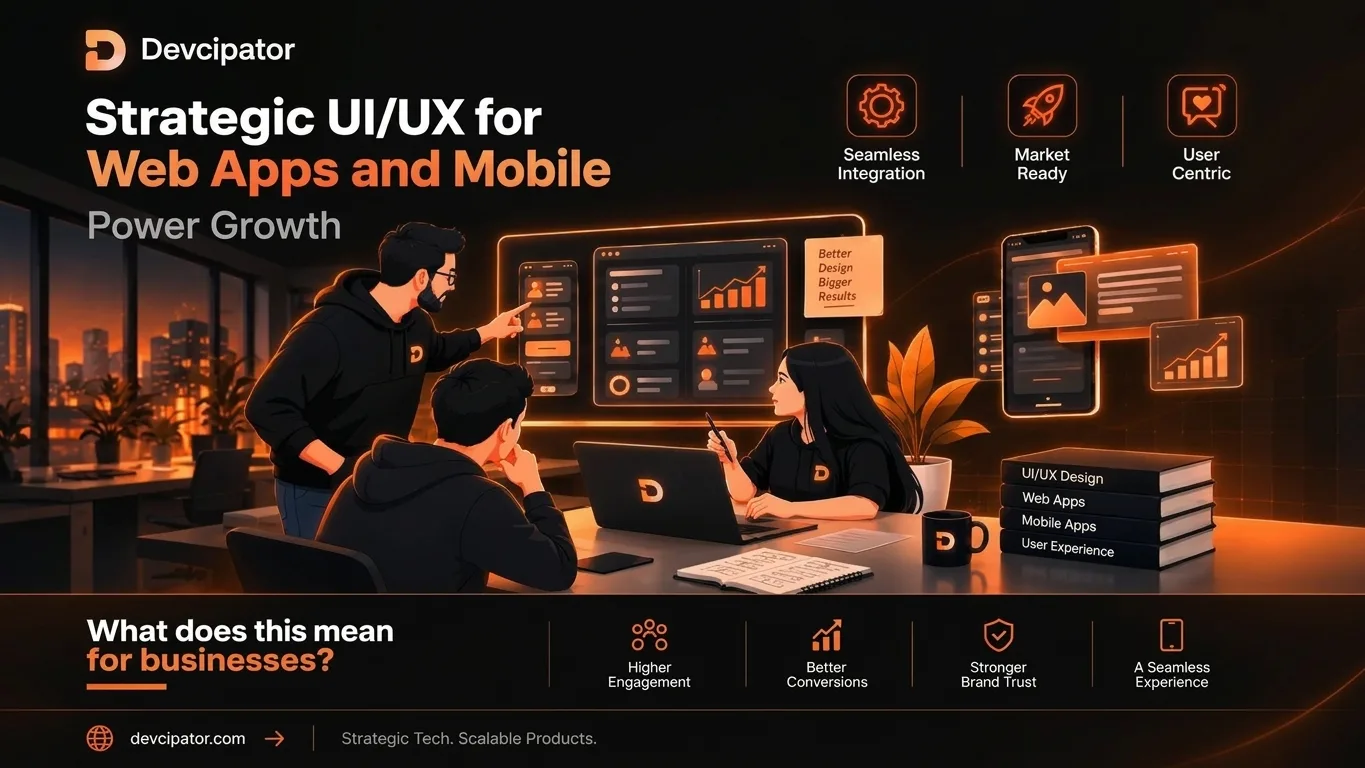
How to Build a Startup in 2026: From Business Idea to a Successful Digital Product
Introduction
Starting a business has never been more exciting, but turning an idea into a successful startup remains a serious challenge. Entrepreneurs have access to powerful technologies, AI tools, no-code platforms, and global markets. Yet many startups still struggle because they invest too much in development before understanding what their customers actually need.
The difference between a promising idea and a sustainable business is execution.
Whether you want to launch a SaaS platform, a mobile application, an AI-powered business tool, or an online marketplace, you need a clear strategy before investing significant time and money.
In this guide, we'll explore how to build a startup in 2026, validate your idea, develop a minimum viable product (MVP), choose the right technology, and create a foundation for long-term growth.
1. Start With a Real Problem, Not Just a Business Idea
One of the most common mistakes entrepreneurs make is starting with a product idea instead of a customer problem.
An idea might sound innovative, but innovation alone doesn't guarantee demand. A successful startup solves a problem that people genuinely experience and, ideally, are willing to pay to solve.
Before developing your product, ask yourself:
Who experiences this problem?
How do they solve it today?
What makes existing solutions frustrating, expensive, or inefficient?
Would customers pay for a better alternative?
Can your solution deliver measurable value?
For example, imagine small businesses spending hours managing customer inquiries, updating spreadsheets, and following up on leads manually. A simple web application that automates these tasks could offer more immediate value than a complicated platform packed with unnecessary features.
The goal is not to build something impressive. It's to build something useful.
2. Validate Your Startup Idea Before Investing in Development
Once you've identified a problem, validate your assumptions before committing to a full product build.
Startup validation helps you understand whether your target audience actually wants your solution. It also reduces the risk of spending your budget on features that customers may never use.
Here are four practical ways to validate an idea:
Conduct customer interviews
Talk to potential customers about their existing challenges. Focus on their current behavior, frustrations, and spending habits rather than simply asking whether they like your idea.
Research competitors
Study similar products to understand their pricing, features, target audiences, and customer complaints. Competition can indicate that demand already exists, while customer dissatisfaction may reveal an opportunity.
Create a landing page
Explain your proposed solution, highlight its benefits, and give visitors a way to register interest, request a demo, or join a waiting list.
Test willingness to pay
Where appropriate, test pricing through paid pilots, preorders, or early-access offers. Positive feedback is useful, but actual purchasing behavior provides stronger evidence of demand.
You don't need perfect certainty before starting. You need enough evidence to make an informed decision about what to build next.
3. Build a Minimum Viable Product (MVP)
After validating your idea, the next step is to develop a minimum viable product.
An MVP is an early version of a product that includes the essential functionality needed to solve a specific customer problem and collect meaningful feedback.
It is not simply a poorly designed product or an unfinished application. A good MVP is focused, usable, and built to test important business assumptions.
For example, if you're developing a project management SaaS platform, your first version might include:
User registration and authentication
Project creation and task management
Team collaboration
Basic notifications
A simple dashboard
Advanced reporting, complex integrations, and enterprise-level customization can come later if customers demonstrate a need for them.
Why MVP development matters
Building a focused MVP allows you to:
Launch earlier and start learning from real users.
Reduce initial development costs.
Identify usability problems before expanding the product.
Test pricing and customer demand.
Prioritize features using actual feedback.
At Devcipator, we help startups transform ideas into functional digital products, including SaaS MVPs, marketplace applications, and AI-powered solutions. The objective is to help founders validate their ideas without unnecessarily complicating the first release.
4. Choose the Right Technology for Your Startup
Technology decisions can influence your development budget, launch timeline, maintenance requirements, and ability to scale.
However, the most advanced technology is not automatically the best choice. Your selection should reflect your product requirements, available resources, expected growth, and long-term goals.
No-code and low-code development
Platforms such as Bubble and FlutterFlow can help teams build applications with less traditional coding. They're particularly useful for many MVPs, internal business tools, and certain SaaS products.
Potential benefits include faster development, visual workflows, and reduced initial engineering overhead.
The trade-offs matter, too. Platform pricing, performance constraints, extensibility, and vendor dependency should be evaluated before committing to a solution.
Custom software development
Frameworks and technologies such as React, Next.js, Node.js, and PostgreSQL can offer greater control over architecture, integrations, and application behavior.
Custom development may be appropriate when a product has specialized requirements, complex workflows, or specific infrastructure and code-ownership needs.
It can also require more engineering effort and ongoing maintenance.
AI-powered application development
AI can support features such as document processing, intelligent search, customer support, content generation, and workflow automation.
However, an AI feature should solve a genuine user problem rather than exist merely because the technology is available.
The best technology is the one that fits your product, budget, users, and growth strategy.
A thoughtful technical plan helps you avoid unnecessary complexity while keeping future options open.
5. Prioritize UI/UX Design From the Beginning
A startup application can have excellent functionality and still struggle if users find it confusing.
User interface (UI) design determines how a product looks, while user experience (UX) design focuses on how people interact with it and accomplish their goals.
Good UI/UX design helps users understand a product, complete important actions, and recognize its value quickly.
For a startup, this means focusing on:
Simple navigation and clear information hierarchy
Straightforward onboarding
Responsive layouts for mobile and desktop
Clear calls to action
Accessible, consistent design elements
User testing and feedback
You don't need dozens of polished screens before launch. You need a coherent experience that makes the product's core functionality easy to understand.
Starting with wireframes and interactive prototypes can also help identify usability issues before development becomes expensive.
6. Plan Your Startup Budget Carefully
Your startup budget should cover more than the initial development of your application.
Founders often underestimate the ongoing costs of operating a digital product. Depending on the business model, expenses may include design, development, hosting, third-party APIs, payment processing, security, marketing, and maintenance.
A practical budget should distinguish between essential launch expenses and costs that can wait until the product gains traction.
Consider the following priorities:
ExpenseInitial priorityCustomer research and validationEssentialMVP design and developmentEssentialHosting and required integrationsBased on product needsMarketing and customer acquisitionEssential to plan forAdvanced featuresAdd when justifiedScaling infrastructureIncrease as demand grows
The objective isn't to spend as little as possible at any cost. It's to allocate resources toward activities that reduce uncertainty and create measurable business value.
A smaller, well-planned launch can be more useful than an expensive product built around untested assumptions.
7. Launch, Collect Feedback, and Improve
Launching your MVP is the beginning of the learning process, not the end of development.
Once real users start interacting with your product, you'll discover which features matter, where people struggle, and what prevents them from becoming paying customers.
Track metrics that reflect your business model, such as:
Activation: How many new users reach a meaningful first milestone?
Retention: Do customers return and continue using the product?
Conversion: How many users become paying customers?
Churn: How many customers stop using or paying for the service?
Customer acquisition cost: How much does it cost to acquire a customer?
Avoid measuring success through downloads or sign-ups alone. A product can attract attention without generating lasting customer value.
Gather feedback, identify recurring problems, and prioritize improvements based on their likely impact.
This iterative approach helps you make better product decisions as your understanding of the market improves.
8. Build for Growth Without Overengineering
Every startup wants to grow, but preparing for growth doesn't mean building a complex enterprise system on day one.
Instead, establish a solid foundation that can evolve with your business.
Important considerations include:
A sensible database structure
Secure authentication and authorization
Reliable backups and error monitoring
Maintainable application architecture
Appropriate API and third-party integrations
Performance testing as usage increases
Clear ownership of data and technical documentation
Your architecture should reflect realistic requirements rather than hypothetical millions of users.
As your customer base expands, you can optimize performance, improve infrastructure, introduce advanced features, and automate additional workflows based on actual demand.
The right balance is to avoid both extremes: building a product that cannot reasonably evolve and spending your entire budget preparing for growth that hasn't happened yet.
9. Use AI and Automation Where They Create Real Value
AI and automation are creating opportunities for startups to deliver services that previously required significant manual effort.
For example, a startup could use AI to categorize support tickets, summarize documents, extract information from business records, or help customers find relevant information.
Automation tools can also connect different systems, reduce repetitive tasks, and streamline internal operations.
But successful AI implementation requires more than connecting an API.
Founders should consider data privacy, output reliability, model costs, human oversight, and what happens when an automated process fails.
Start with a clearly defined workflow. Measure the time saved or the improvement in customer outcomes, then expand only when the results justify it.
This approach turns AI from a marketing feature into a practical business capability.
10. Choose a Development Partner That Understands Startups
For founders without an in-house technical team, choosing the right development partner can significantly influence the product's direction.
Look beyond a company's ability to write code. A strong partner should understand product requirements, user experience, technical trade-offs, and the commercial goals behind the application.
Before starting a project, discuss:
Your target audience and core business problem
The scope of the first release
Technology choices and their trade-offs
Development milestones and testing
Ownership of code, data, and accounts
Documentation, handover, and ongoing support
Clear communication and realistic expectations help prevent scope creep, misunderstandings, and unnecessary development costs.
At Devcipator, we work with founders and businesses to plan, design, and build digital products, from early-stage MVPs to SaaS platforms and AI-powered applications. Our focus is on helping teams turn ideas into useful products with a practical path from launch to growth.
Common Startup Mistakes to Avoid
Even promising ideas can struggle when founders make avoidable decisions early in the process.
Building too many features: Start with the core problem and expand when customer feedback supports it.
Ignoring market validation: Research demand before investing heavily in development.
Choosing technology based only on trends: Evaluate the trade-offs instead of following hype.
Neglecting user experience: Make the product intuitive, not merely functional.
Underestimating operating costs: Account for hosting, integrations, maintenance, and customer acquisition.
Scaling before finding product-market fit: Focus on retention and repeatable demand before aggressively expanding.
Treating launch as the finish line: Continue testing, learning, and improving after release.
Avoiding these mistakes won't guarantee success, but it can help you make more informed decisions with limited time and resources.
Conclusion: Turn Your Startup Idea Into a Product That Solves a Real Problem
Building a startup in 2026 is not simply about having a creative idea or access to modern technology. It's about understanding customers, validating demand, choosing an appropriate development strategy, and continuously improving your product.
Start with a genuine problem. Validate your assumptions. Build a focused MVP. Choose technology that fits your needs. Learn from real users, and invest in growth when the evidence supports it.
You don't have to build everything at once. You have to take the right next step.
Ready to Build Your Startup MVP?
Have a startup idea but aren't sure how to turn it into a working product?
Devcipator can help you move from concept to launch. Whether you're planning a SaaS platform, a mobile application, a web app, or an AI-powered solution, our team can help you explore the right approach for your product.
Visit Devcipator.com to learn more about our digital product development services and discuss your startup idea with our team.
Related articles
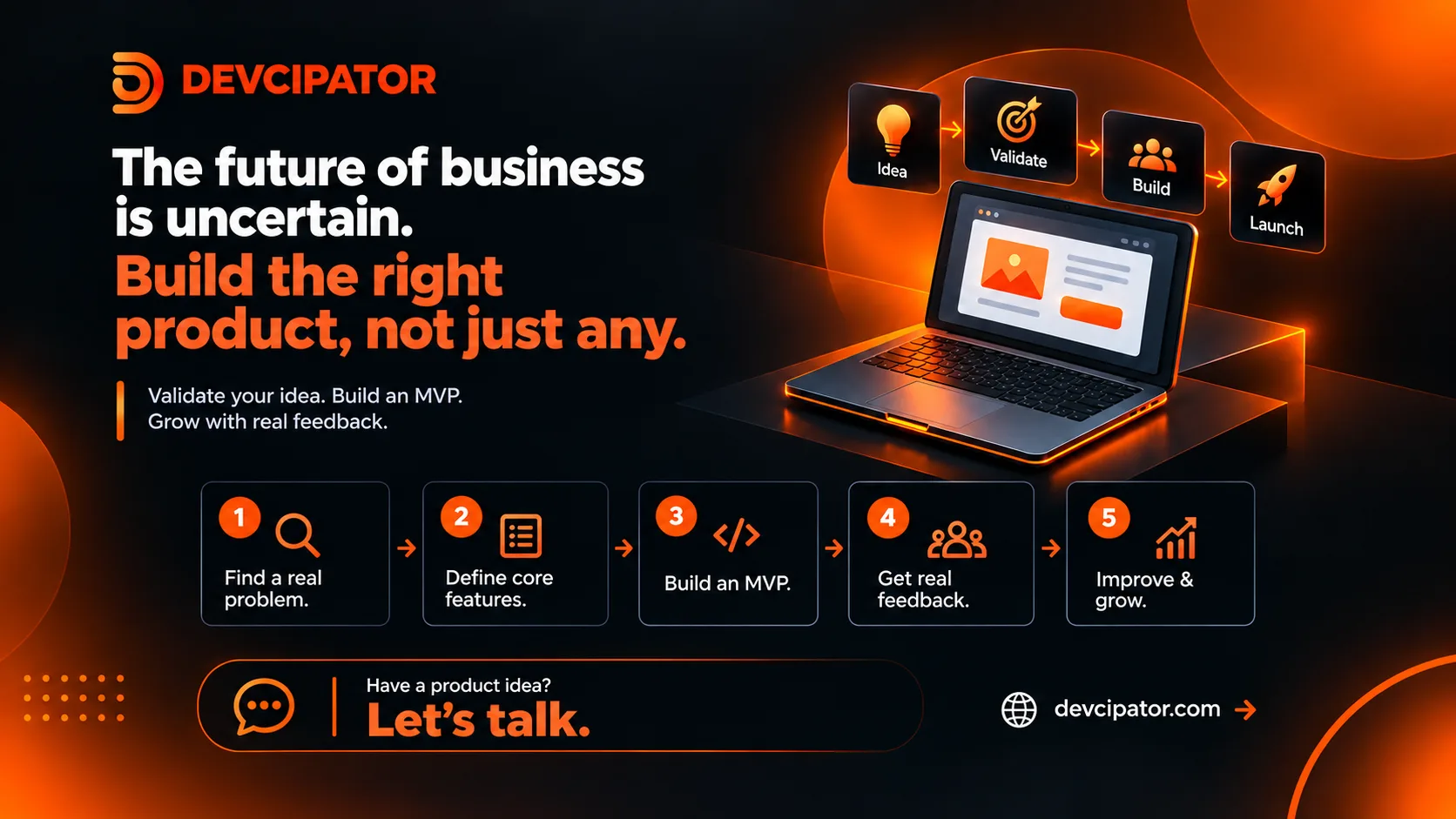
Building Your Next Product Shouldn’t Be a Guessing Game
Markets are unpredictable and budgets are tighter. Before you invest in a new product, validate the idea with a focused MVP and build the right thing first.
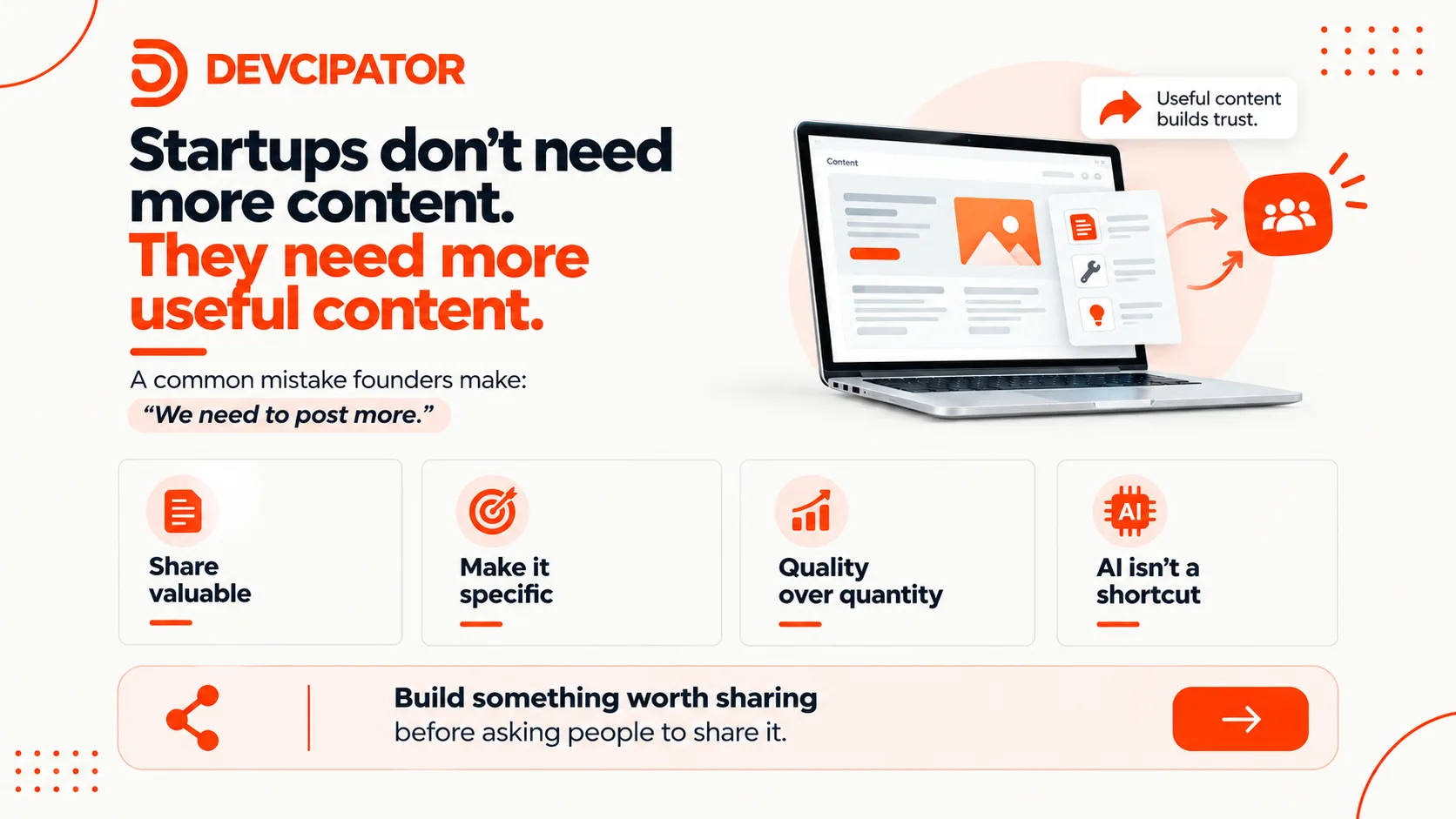
Startups Don't Need More Content. They Need More Useful Content.
Posting more won't fix your distribution. Before asking people to buy, book a call, or try your product, give them something that solves a real problem.
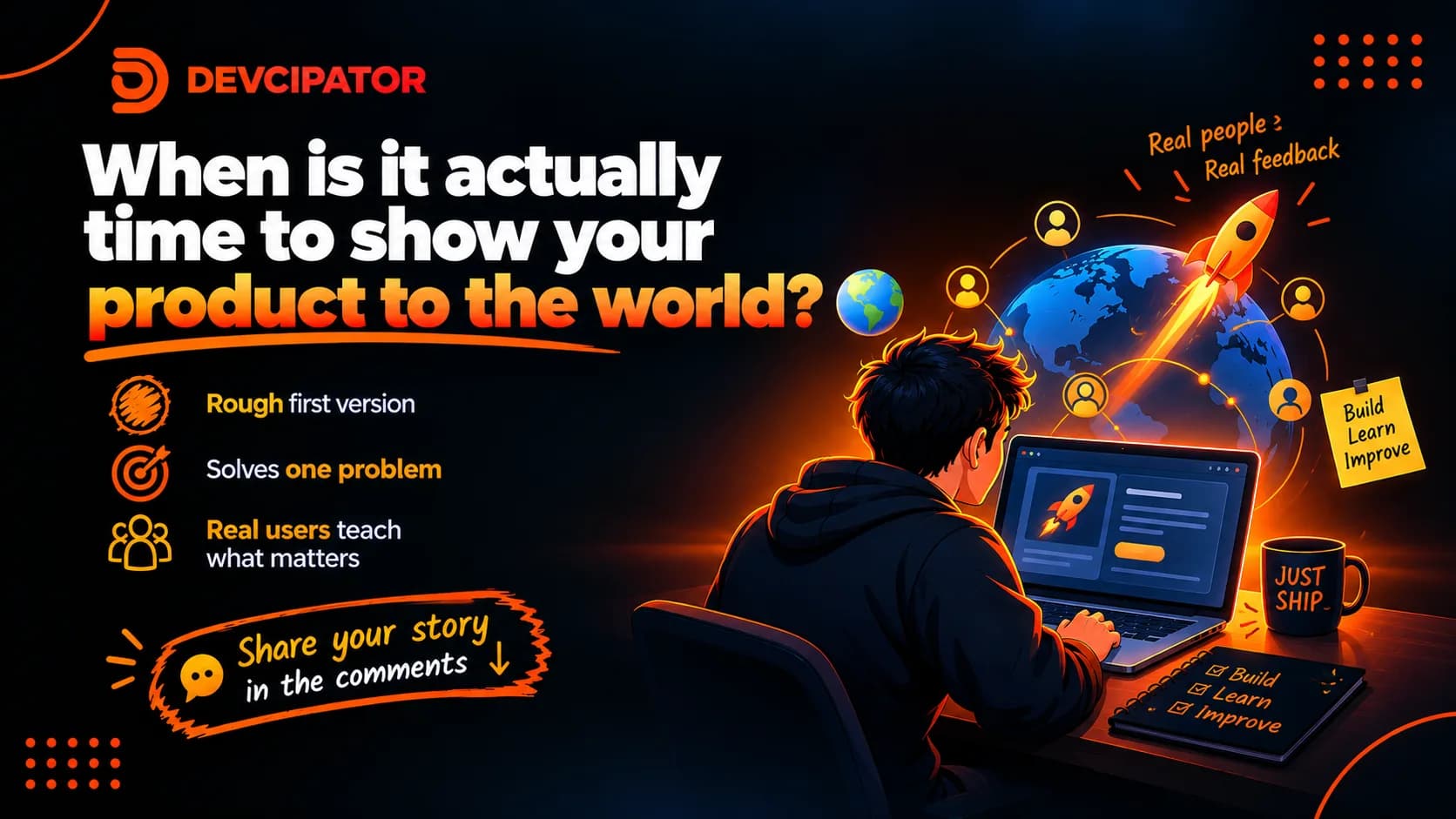
When Should You Stop Building and Start Getting Users?
There's always one more feature to add and one more bug to fix. Here's why waiting for "perfect" costs you more than launching early, and what your first version really needs to look like.