
AI Agents vs. AI Chatbots: What's the Difference and Which Does Your Business Need in 2026? Copy title
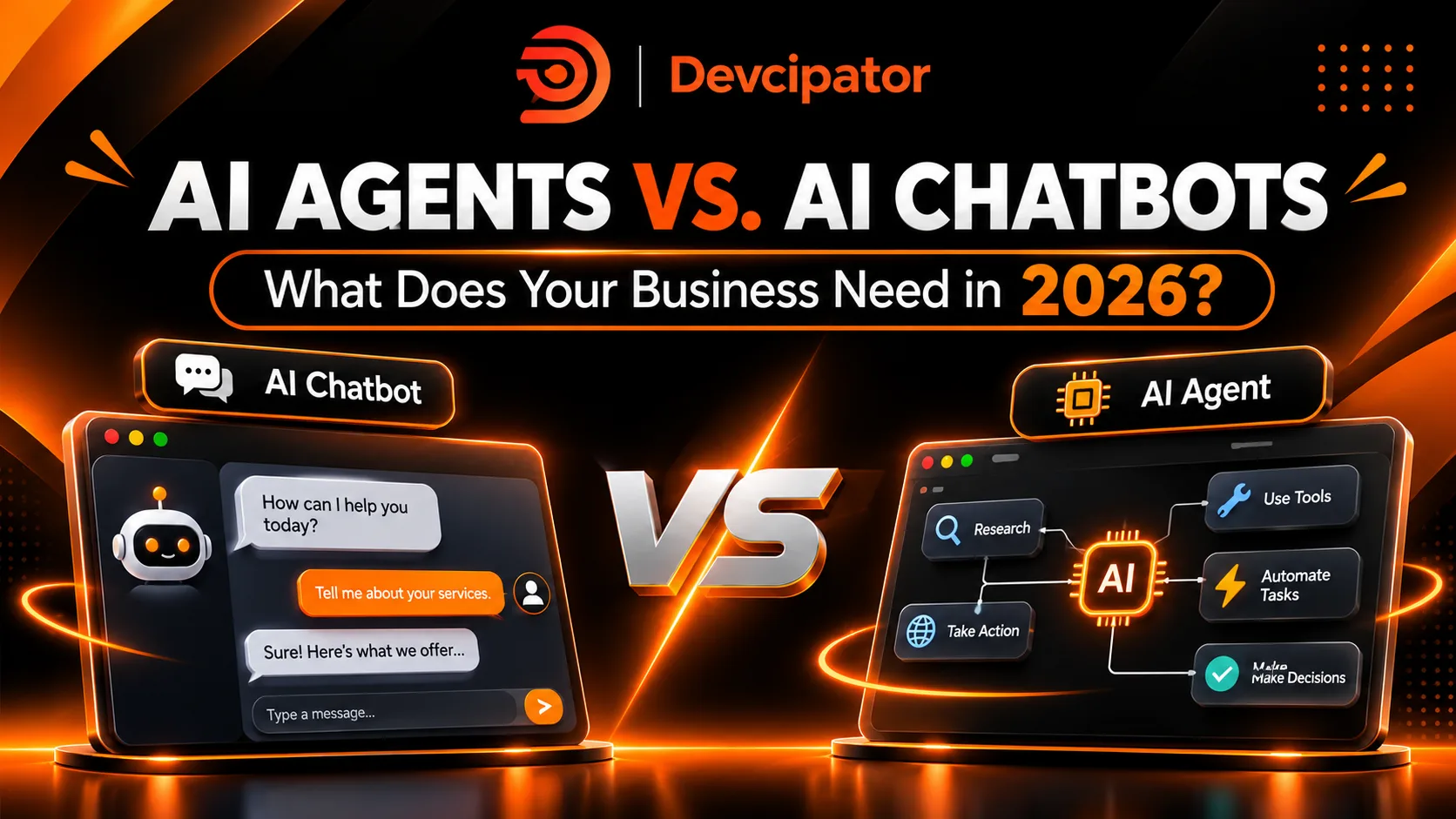
AI Agents vs. AI Chatbots: What's the Difference and Which Does Your Business Need in 2026?
Artificial Intelligence is changing how businesses communicate with customers, manage operations, and deliver services. From answering customer questions to automating complex business workflows, AI is becoming an important part of modern digital products.
Two technologies gaining significant attention are AI chatbots and AI agents.
Although these terms are sometimes used interchangeably, they serve different purposes. AI chatbots primarily interact with users through conversations, while AI agents can go further by planning tasks, using tools, and taking actions toward specific goals.
But which technology should your business invest in?
Should you build an AI chatbot to improve customer support, or should you implement AI agents to automate business processes?
In this guide, we'll explore the differences between AI agents and AI chatbots, their business applications, benefits, limitations, and how to choose the right solution for your company.
What Is an AI Chatbot?
An AI chatbot is a software application that communicates with users through text or voice conversations.
Modern AI chatbots use artificial intelligence and natural language processing to understand questions, generate responses, and provide relevant information.
Unlike traditional rule-based chatbots, which follow predefined conversation paths, AI-powered chatbots can understand more flexible language and handle a wider range of questions.
For example, imagine a customer visiting an online store.
Instead of searching through multiple pages, the customer can ask:
What products do you recommend?
How long does delivery take?
Can I return my order?
Do you have this product in another size?
An AI chatbot can understand these questions and provide relevant answers based on its available information.
Common Applications of AI Chatbots
Businesses use AI chatbots for several purposes:
1. Customer Support
Answer frequently asked questions, explain services, and help customers find information.
2. Lead Generation
Ask potential customers relevant questions, collect contact details, and qualify leads.
3. Website Assistance
Help website visitors navigate services, explore products, and find relevant information.
4. Appointment Booking
Guide users through available services, appointment preferences, and booking processes.
5. Internal Knowledge Assistance
Help employees find information from company documents, knowledge bases, and internal resources.
AI chatbots can improve communication and reduce repetitive support tasks when they are connected to accurate information.
What Are AI Agents?
AI agents are systems designed to work toward specific goals by reasoning through tasks, selecting actions, and interacting with available tools or systems.
Unlike a basic conversational chatbot, an AI agent can perform multiple steps to complete a task.
Depending on its design and permissions, an AI agent may:
Understand a user's objective.
Break a complex task into smaller steps.
Retrieve information from external sources.
Use APIs and connected tools.
Execute approved actions.
Evaluate results and determine the next step.
For example, imagine a business wants to automate its customer onboarding process.
An AI agent could be designed to:
Receive a new customer inquiry.
Analyze the information provided.
Check the customer's requirements.
Retrieve relevant information from a connected CRM.
Prepare a personalized response.
Create a follow-up task for the sales team.
This goes beyond simply answering questions. The agent helps move an entire workflow forward.
However, AI agents should operate within clearly defined permissions, validation rules, and human approval requirements, especially when handling sensitive information or important business decisions.
Common Applications of AI Agents
1. Sales Automation
Research potential customers, organize lead information, and prepare follow-up activities.
2. Business Process Automation
Coordinate repetitive tasks across connected business applications.
3. Document Processing
Extract information from documents, categorize content, and send results to relevant systems.
4. Customer Service Operations
Retrieve customer information, check order details, and perform approved support actions.
5. Workflow Management
Coordinate multiple steps across different tools to complete business processes.
AI agents are particularly useful when businesses need more than automated conversations.
AI Agents vs. AI Chatbots: Key Differences
Both technologies use artificial intelligence, but their capabilities and responsibilities can be different.
Here is a practical comparison:
FeatureAI ChatbotsAI AgentsMain PurposeCommunicate with usersComplete specific goalsPrimary FunctionAnswer questionsPlan and perform tasksInteractionMostly conversationalConversational and action-orientedTool UsageOptional integrationsOften connected to toolsDecision MakingResponse generationTask planning and action selectionAutomationLimited or workflow-basedMulti-step task automationComplexityUsually simplerOften more complexHuman OversightDepends on use caseImportant for sensitive actions
One important distinction: the two technologies are not completely separate.
A chatbot can use tools, and an AI agent can communicate through a chat interface. The real difference is the system's responsibilities, autonomy, planning capabilities, and ability to take actions.
5 Benefits of AI Chatbots for Businesses
AI chatbots can help businesses improve customer communication without requiring employees to manually respond to every common question.
1. Faster Customer Responses
Customers expect quick answers when interacting with a business.
AI chatbots can provide immediate responses to common questions, helping customers find information without waiting for a support representative.
2. Better Customer Experience
A well-designed chatbot makes it easier for users to navigate services, understand products, and get relevant information.
When connected to the right knowledge sources, it can provide more useful and consistent responses.
3. Reduced Repetitive Work
Customer support teams often spend considerable time answering similar questions.
Chatbots can handle routine inquiries, allowing employees to focus on complicated issues that require human attention.
4. Continuous Availability
Unlike human support teams with fixed working hours, AI chatbots can respond to users outside normal business hours.
This can help businesses maintain communication with customers across different time zones.
5. Improved Lead Qualification
Chatbots can ask visitors questions about their needs, budgets, and requirements.
The collected information can help sales teams identify promising leads and prioritize follow-ups.
5 Benefits of AI Agents for Businesses
AI agents offer another level of automation by helping businesses coordinate tasks across different systems.
1. Automate Multi-Step Workflows
Some business processes involve multiple actions across different applications.
An AI agent can coordinate these actions using connected tools and defined workflows.
For example, an agent could collect customer information, check records, prepare a response, and create a follow-up task.
2. Reduce Manual Data Handling
Employees often spend time transferring information between spreadsheets, databases, and business applications.
AI agents can help retrieve, organize, and process information across connected systems.
3. Improve Operational Efficiency
By automating suitable repetitive tasks, businesses can reduce manual effort and allow employees to focus on strategic activities.
4. Connect Different Business Tools
AI agents can interact with APIs, databases, CRM systems, and other business applications when properly integrated.
This makes it possible to coordinate workflows that would otherwise require multiple manual steps.
5. Support Better Decision-Making
AI agents can gather relevant information, summarize findings, and prepare recommendations.
However, important business decisions should still have appropriate human review and approval.
Real-World Examples: Which Technology Should You Use?
Understanding the differences becomes easier when you look at practical business scenarios.
Example 1: E-Commerce Business
An online store wants to improve its customer experience.
With an AI Chatbot:
Answer product-related questions.
Explain shipping and return policies.
Recommend products based on customer preferences.
Help customers navigate the website.
With an AI Agent:
Retrieve order information.
Check inventory through connected systems.
Coordinate approved return workflows.
Prepare customer support actions.
Best approach: A chatbot may be sufficient for basic customer assistance, while an agent can help automate more complex operations.
Example 2: Real Estate Business
A real estate company receives hundreds of property inquiries.
With an AI Chatbot:
Answer questions about available properties.
Ask about location preferences.
Collect customer requirements.
Help visitors request property details.
With an AI Agent:
Retrieve matching properties from a database.
Organize qualified leads.
Prepare follow-up tasks.
Coordinate approved appointment scheduling.
Best approach: A combination can provide conversational assistance and operational automation.
Example 3: SaaS Business
A SaaS company wants to improve its user onboarding process.
With an AI Chatbot:
Explain platform features.
Answer common user questions.
Guide users through basic setup.
With an AI Agent:
Analyze onboarding progress.
Identify incomplete setup steps.
Retrieve relevant account information.
Trigger approved reminders and workflows.
Best approach: Combining both technologies can create a more complete onboarding experience.
How to Choose Between AI Agents and AI Chatbots
Before investing in AI development, identify the actual problem you want to solve.
The right technology depends on your business objectives, workflow complexity, available data, integrations, and budget.
Consider these questions:
1. Do You Mainly Need Better Communication?
If your goal is to answer questions, provide recommendations, or assist website visitors, an AI chatbot may be the right starting point.
2. Do You Need to Automate Multiple Tasks?
If your business requires AI to interact with different applications, process information, and perform multi-step workflows, AI agents may be more appropriate.
3. What Systems Need to Be Connected?
Consider whether your solution needs access to a CRM, database, payment system, document storage, or other external applications.
4. How Much Control Is Required?
Define which actions AI can perform independently and which require human approval.
5. What Is Your Expected Return?
Consider development costs, AI model usage, maintenance, integration expenses, and the time saved through automation.
A smaller, focused AI solution can often deliver more value than an unnecessarily complicated system.
Can AI Agents and Chatbots Work Together?
Absolutely.
In many business applications, combining AI agents and chatbots creates a more useful experience.
Think of an AI chatbot as the conversational interface and an AI agent as the system responsible for completing specific tasks behind the scenes.
For example, imagine a customer using an AI-powered service platform.
The customer asks:
"Can you check my booking and reschedule it for tomorrow?"
The chatbot can understand the request and communicate with the customer.
An integrated agent can then:
Retrieve the customer's booking information.
Check available appointment slots.
Present suitable options.
Request customer confirmation.
Update the booking through an authorized integration.
Send a confirmation message.
This combination connects natural conversation with real business functionality.
It is important to implement authentication, permission checks, error handling, and confirmation steps before allowing AI systems to modify important records.
What Does It Take to Build an AI-Powered Application?
Building an AI-powered application involves more than connecting an AI model to a website.
A successful product needs a clear purpose, reliable integrations, a good user experience, and a suitable technical architecture.
Here are some important components:
1. AI Model Integration
Choose an appropriate AI model based on the application's requirements, accuracy expectations, latency, and operating costs.
2. Backend Development
Build the backend logic responsible for processing requests, communicating with AI models, and managing application data.
3. API Integrations
Connect the application with external services, databases, and business tools.
4. Data Management
Ensure that information is stored, retrieved, and processed securely.
5. User Interface and Experience
Create a simple interface that makes AI functionality easy to understand and use.
6. Testing and Monitoring
Test real-world scenarios, monitor performance, evaluate response quality, and improve the system over time.
7. Security and Human Oversight
Implement access controls, data protection measures, action limits, and human approval for sensitive operations.
These elements help turn an AI demonstration into a practical business application.
How Devcipator Helps Businesses Build AI-Powered Solutions
At Devcipator, we believe AI should solve real problems rather than simply add another feature to an application.
We help startups, entrepreneurs, and established businesses turn AI ideas into practical digital products.
Our AI development services cover several areas:
AI-Powered Applications
We build applications that integrate modern AI capabilities into useful business products and workflows.
AI Chatbots
We develop conversational solutions that help businesses improve customer communication, provide assistance, and make information more accessible.
AI Agents and Automation
We design AI agents and automated workflows that help businesses reduce repetitive manual tasks and coordinate operations across connected systems.
Document Intelligence
We build solutions that help process, analyze, and retrieve information from business documents.
AI-Powered SaaS Products
We integrate AI functionality into SaaS platforms to create intelligent features and improve product experiences.
Custom AI Integrations
We connect AI models with existing applications, APIs, databases, and external services based on business requirements.
Our development process includes:
Discovery and requirement analysis.
Product strategy and technical planning.
UI/UX design.
Application and AI development.
Testing and quality assurance.
Deployment and launch.
Ongoing support and improvements.
We focus on building solutions that are useful, reliable, and designed around actual business needs.
Whether you want to build an AI chatbot, automate business operations, or launch an AI-powered SaaS product, choosing the right development approach is the first step.
Conclusion
AI chatbots and AI agents are both valuable technologies, but they solve different problems.
AI chatbots help businesses communicate with users, answer questions, and provide assistance.
AI agents go further by helping systems plan tasks, interact with tools, and execute multi-step workflows within defined permissions.
The best choice depends on what your business actually needs.
If you want better customer communication, start by exploring AI chatbots. If you want to automate complex processes, AI agents may be a better fit. And if you want a more complete solution, combining both technologies can create powerful business applications.
The goal isn't to use AI just because it's popular. It's to use the right technology to solve meaningful problems.
Ready to turn your AI idea into a real product?
Devcipator helps businesses build AI-powered applications, intelligent chatbots, AI agents, automation systems, and scalable digital products.
Let's discuss your idea and explore how we can bring it to life.
Visit: https://www.devcipator.com/services/ai-development
Book a free consultation and start building smarter with AI.
Frequently Asked Questions
1. What is the main difference between AI agents and AI chatbots?
AI chatbots primarily communicate with users and answer questions, while AI agents can plan and execute tasks using connected tools and systems. Some modern chatbots also have agent-like capabilities.
2. Can an AI chatbot become an AI agent?
A chatbot can be extended with tools, APIs, planning capabilities, and permission-controlled actions. With the right architecture, it can become part of an agentic system.
3. Are AI agents better than AI chatbots?
Not necessarily. AI chatbots are suitable for conversational tasks, while AI agents are useful for more complex workflows. The best option depends on your business requirements.
4. Can AI agents automate business processes?
Yes. AI agents can coordinate multi-step processes, retrieve information, interact with external tools, and execute approved actions.
5. Are AI agents expensive to build?
Costs depend on the complexity of the system, AI models, integrations, infrastructure, data requirements, and maintenance. Starting with a focused use case can help control costs.
6. Can AI agents and chatbots integrate with existing applications?
Yes. Both can integrate with existing applications through APIs and other supported connections, depending on the technology and system architecture.
7. How can Devcipator help build an AI-powered application?
Devcipator provides AI application development, chatbot development, AI agents and automation, document intelligence, AI integrations, and SaaS product development to help businesses turn ideas into practical digital solutions.
Related articles
How to Build and Scale AI-Powered MVPs Without Overbuilding
Discover how founders can validate AI startup ideas, avoid common over-engineering traps, and launch scalable AI-powered products faster using visual development and modern API connectors.
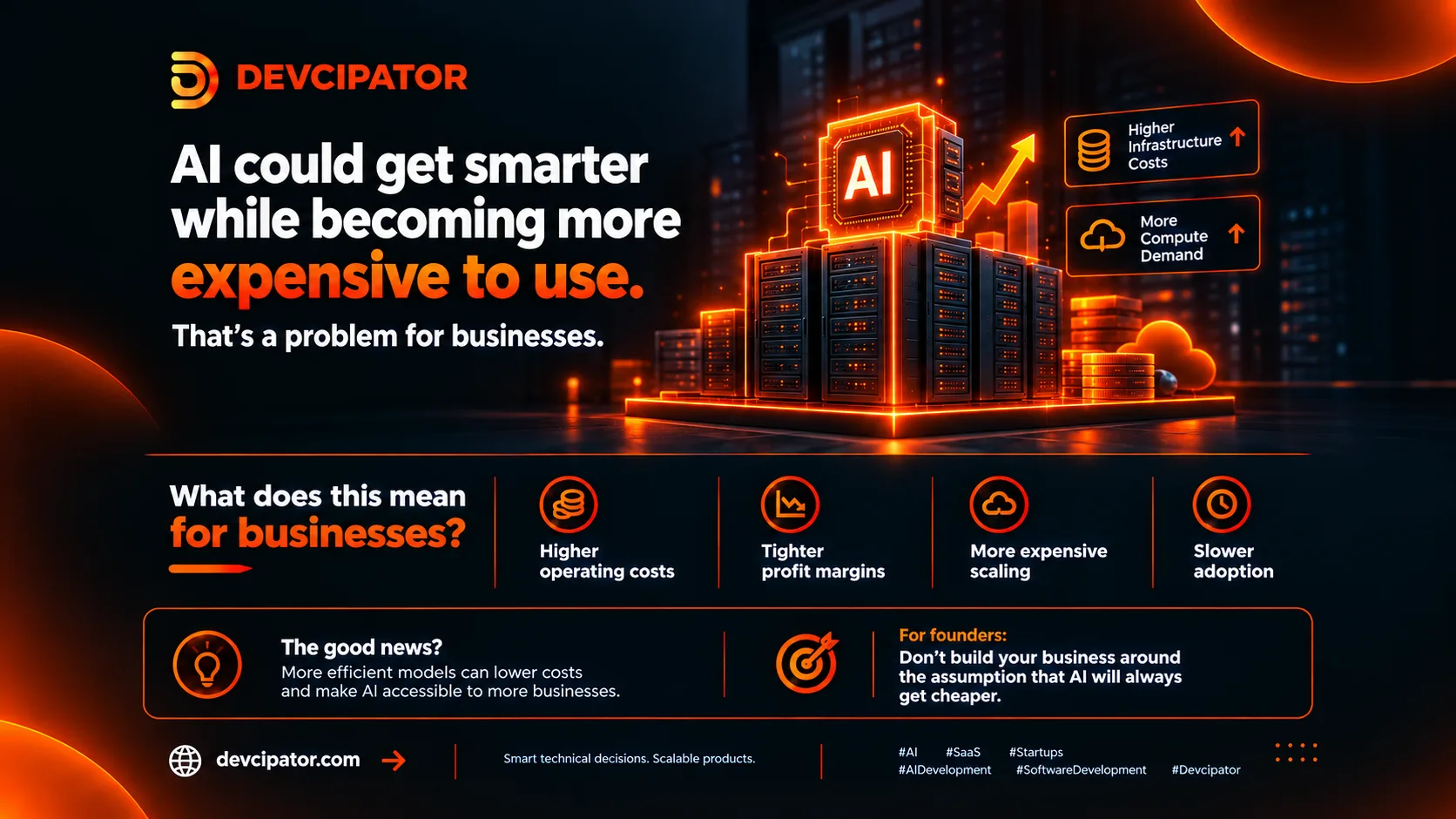
Smarter AI, Higher Bills: What Rising AI Costs Mean for Your Business
AI models are getting smarter, but they are also getting more expensive to run. Here’s what rising AI costs mean for startups and SaaS businesses, and how to build products that can adapt.
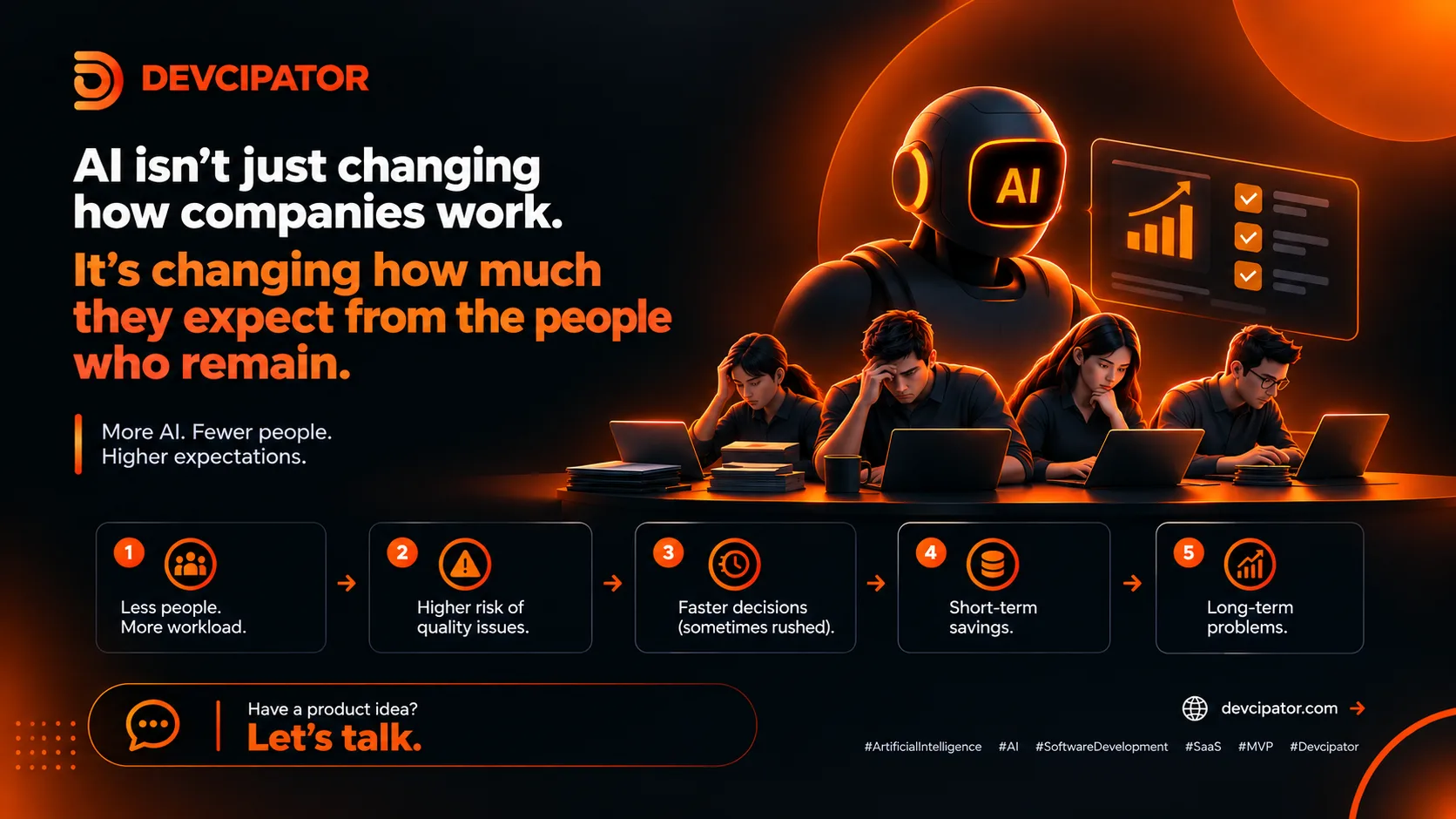
Build Better With What You Have: Why Doing More With Less Isn’t Always Smarter
AI is raising expectations for smaller teams, but doing more with fewer people doesn’t always mean building a better business. Here’s why quality, judgment, and lasting value still matter.