
SaaS Product Development: A Complete Guide to Building Scalable Software in 2026
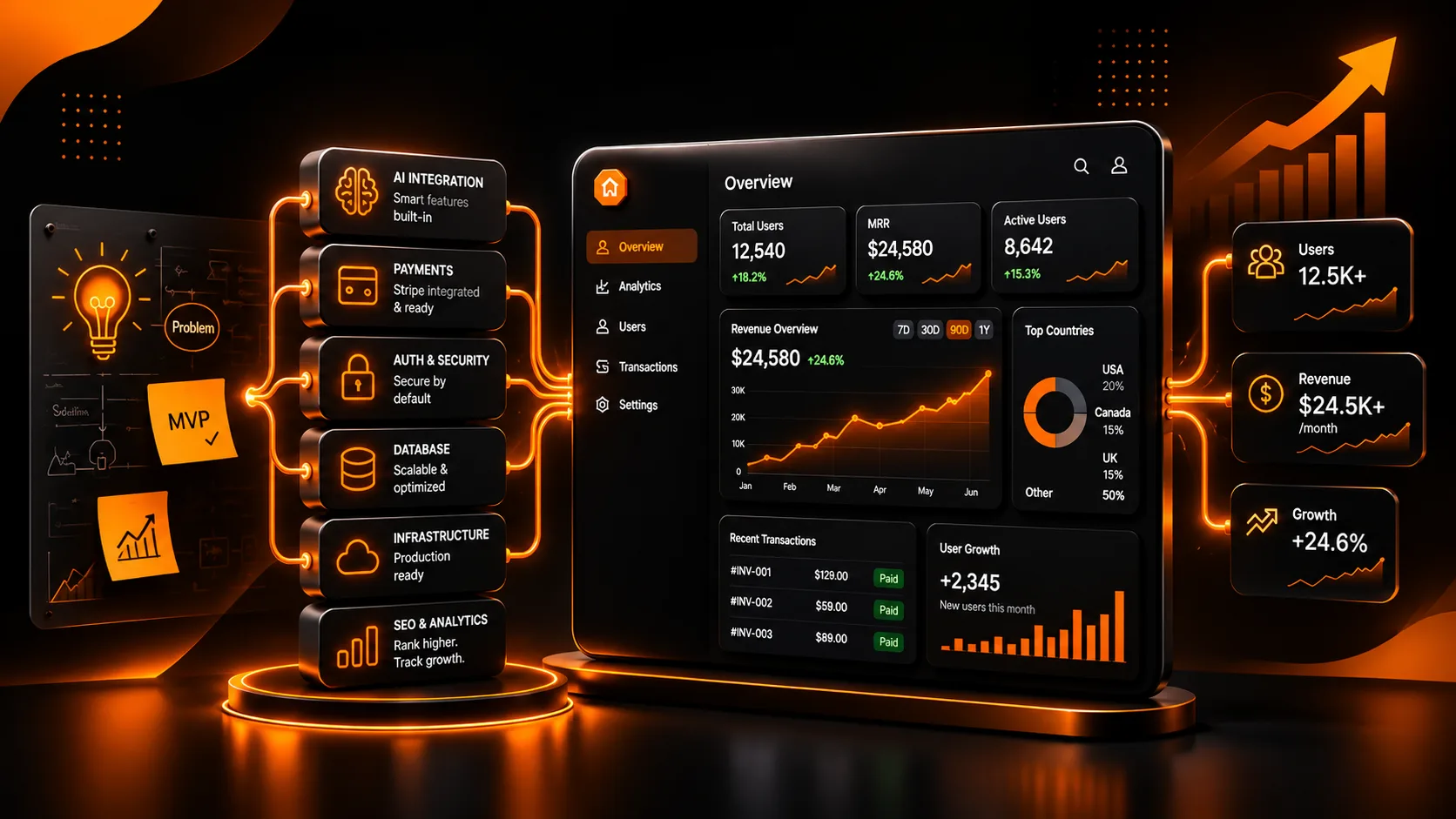
SaaS Product Development: A Complete Guide to Building Scalable Software in 2026
Software as a Service (SaaS) has transformed how businesses access software, manage operations, and deliver digital solutions. Instead of installing applications on individual computers, users can access cloud-based software through a web browser or application, usually through a subscription or usage-based pricing model.
For startups and established businesses, SaaS offers an opportunity to create recurring revenue, reach customers online, and build products that evolve alongside changing business needs.
However, launching a successful SaaS product requires more than developing an application. It involves identifying a real problem, understanding customers, designing intuitive experiences, choosing the right technology, and building a reliable platform that can grow over time.
In this guide, we'll explore what SaaS is, how SaaS product development works, which features matter, and how businesses can approach building scalable SaaS applications.
What Is SaaS?
Software as a Service (SaaS) is a software delivery model in which applications are hosted by a provider and made available to customers over the internet.
Users typically access SaaS applications through a browser or supported application without managing the underlying infrastructure themselves.
Common SaaS examples include:
Customer relationship management (CRM) platforms
Project management applications
Accounting and financial management software
Marketing automation platforms
Collaboration tools
Business intelligence dashboards
AI-powered business applications
Many SaaS products use recurring subscriptions, although some offer usage-based pricing, free plans, or a combination of pricing models.
The SaaS model allows businesses to maintain and improve software centrally while customers access the service through their accounts.
Why Businesses Are Investing in SaaS Product Development
SaaS development provides opportunities for businesses to create digital products that serve customers continuously rather than delivering software as a one-time transaction.
1. Recurring Revenue Opportunities
Subscription-based SaaS products can generate recurring revenue when customers continue using and paying for the service.
This creates an opportunity for businesses to develop predictable revenue streams, although actual revenue depends on customer acquisition, retention, pricing, and operating costs.
2. Easier Product Updates
Because SaaS applications are centrally managed, developers can release improvements, fix bugs, and introduce features without requiring customers to manually install every update.
A structured release process helps businesses maintain their applications and improve the user experience over time.
3. Flexible Growth
SaaS products can be designed to support increasing numbers of users, customers, and transactions.
With appropriate architecture and infrastructure, businesses can expand their applications as demand grows.
Scalability is not automatic, however. It requires thoughtful technical decisions, performance monitoring, and ongoing optimization.
4. Access From Different Devices
Web-based SaaS applications can provide convenient access across supported devices.
Responsive UI/UX design helps customers use the application on desktops, tablets, and smartphones without sacrificing usability.
5. Continuous Product Improvement
SaaS businesses can collect feedback, analyze product usage, and identify opportunities to improve their applications.
This supports an ongoing product development cycle in which businesses refine features according to customer needs.
Essential Features of a SaaS Application
A successful SaaS platform needs more than an attractive dashboard. Its features should support customer workflows, security, administration, and business operations.
User Authentication and Account Management
Users need secure ways to register, log in, manage their accounts, and recover access when necessary.
Depending on the product, authentication may include email verification, multi-factor authentication, or single sign-on.
Subscription and Billing Management
Subscription-based applications need a reliable way to manage plans, payments, renewals, and subscription changes.
Payment integrations such as Stripe can help businesses implement supported billing workflows.
The application should also provide clear information about subscription status, billing history, and available plans.
User Roles and Permissions
Many SaaS applications support different user roles.
For example, an organization may have:
Owner
Administrator
Manager
Team member
Role-based access control helps ensure that users can access the information and actions appropriate to their responsibilities.
Dashboard and Reporting
A dashboard should present relevant information clearly and help users understand what is happening inside their accounts.
Useful dashboards may include activity summaries, performance metrics, notifications, and shortcuts to important actions.
Avoid adding unnecessary charts or metrics that make the interface harder to understand.
Multi-Tenant Architecture
Many SaaS platforms serve multiple organizations through a shared application.
A multi-tenant architecture allows different customers to use the same product while keeping their data appropriately separated.
The implementation must carefully consider authorization, tenant isolation, database structure, and security.
Notifications and Communication
Notifications can help users stay informed about important events.
Examples include:
Account activity
Subscription changes
Workflow completion
Team invitations
Important reminders
Notifications should be relevant and configurable rather than overwhelming users.
Administration and Support
SaaS businesses often need administrative tools to manage accounts, monitor platform activity, investigate issues, and support customers.
These tools should include appropriate access controls and audit capabilities for sensitive administrative actions.
SaaS Product Development: Step-by-Step Process
Building a SaaS platform successfully requires a structured development process. Each stage helps reduce uncertainty and improve the quality of the final product.
Step 1: Validate the SaaS Idea
Start by identifying a problem customers genuinely experience.
Ask questions such as:
Who is the target customer?
What problem are they trying to solve?
How do they solve it today?
What makes existing solutions difficult or expensive?
Would customers pay for a better solution?
Customer interviews, competitor research, and early product validation can help determine whether the idea deserves further investment.
The goal is to understand the market before committing significant resources to development.
Step 2: Define the MVP
A Minimum Viable Product (MVP) is a focused version of a product designed to test its core value with real users.
Instead of building every possible feature, identify the essential functionality needed to solve the primary problem.
For example, a SaaS appointment management platform might begin with:
User registration
Service management
Appointment scheduling
Booking confirmation
Basic customer management
Advanced analytics, complex automation, and additional integrations can be considered later.
A focused MVP helps businesses validate assumptions, collect feedback, and make informed decisions about future development.
Step 3: Plan the Product Architecture
Architecture decisions influence how the application handles users, data, integrations, and future growth.
Important considerations include:
Database design
Authentication and authorization
Tenant isolation
API structure
Hosting and infrastructure
Data backups
Monitoring and logging
Security requirements
The right architecture depends on the product's complexity, expected usage, technical requirements, and available resources.
Avoid unnecessary complexity during the early stages, but do not ignore fundamental security or data integrity requirements.
Step 4: Design the UI/UX
Before development begins, design the user experience around the tasks customers need to complete.
This includes:
User flows
Wireframes
Dashboard layouts
Navigation
Onboarding
Forms and interactions
Responsive layouts
Design systems
Tools such as Figma can help teams create prototypes, review screens, and validate workflows before implementing them.
Good SaaS design should make important features easy to find and everyday tasks easy to complete.
Step 5: Develop the SaaS Application
Once the product scope and designs are approved, development can begin.
Depending on the project, businesses may choose:
Bubble for visual application development
React and Next.js for modern web interfaces
Node.js for backend development
Supabase or Firebase for supported backend services
PostgreSQL for relational data
Cloud platforms for hosting and infrastructure
The technology stack should be selected according to the product's requirements rather than simply following trends.
Development should focus on building essential functionality, maintaining code or workflow quality, and integrating required services.
Step 6: Test the Application
Testing helps identify problems before customers encounter them.
Important testing areas include:
Authentication and account management
User permissions
Subscription and billing workflows
Data validation
Responsive layouts
API integrations
Performance
Security
Error handling
SaaS applications should also be tested with different user roles and realistic workflows.
A successful development process includes testing throughout development, not only immediately before launch.
Step 7: Launch and Monitor
Launching a SaaS product is the beginning of its operational lifecycle.
After deployment, businesses should monitor:
Application availability
Performance
Error rates
Database health
Security events
User activity
Customer feedback
Monitoring helps teams identify problems and respond before they significantly affect customers.
Step 8: Improve and Scale
Once customers begin using the application, their feedback and usage patterns can inform product improvements.
Businesses may introduce new features, improve workflows, optimize infrastructure, or expand integrations.
The objective is to grow the product according to actual customer needs rather than adding features without a clear purpose.
Choosing Between No-Code, Low-Code, and Custom SaaS Development
The development approach affects speed, cost, flexibility, and long-term maintenance.
No-Code SaaS Development
No-code platforms allow teams to build applications using visual interfaces and configuration rather than writing most application code manually.
Bubble is one example of a platform used to build web applications, including SaaS products.
No-code development can be useful for:
Startup MVPs
Internal business applications
Workflow-based platforms
Early-stage SaaS products
Products with suitable integration requirements
The platform should still be evaluated for its data structure, security, performance, integrations, and long-term product requirements.
Low-Code SaaS Development
Low-code development combines visual development tools with custom code where needed.
This can help teams accelerate application development while retaining flexibility for more specialized functionality.
Low-code approaches may be suitable when a product requires custom integrations, more complex workflows, or additional technical control.
Custom SaaS Development
Custom development gives teams greater control over architecture, implementation, infrastructure, and specialized requirements.
It may be appropriate for products that require:
Complex business logic
Specialized integrations
Advanced infrastructure control
Highly customized workflows
Specific performance requirements
Custom development also requires careful consideration of development time, engineering resources, maintenance, and infrastructure costs.
There is no single best approach for every SaaS product. The right choice depends on the product's requirements and business objectives.
Common SaaS Development Mistakes to Avoid
Many SaaS projects encounter challenges that could be reduced through better planning and execution.
Building Too Many Features
Adding unnecessary features before validating the core product increases development complexity and can delay launch.
Start with the most important customer problem and expand according to feedback.
Ignoring Security
SaaS applications often handle customer accounts, business information, and sensitive data.
Security should be considered throughout development, including authentication, authorization, tenant isolation, secure integrations, backups, and monitoring.
Designing a Confusing User Experience
A powerful application can struggle if users cannot understand how to use it.
Invest in user research, intuitive navigation, clear onboarding, and usability testing.
Choosing Technology Without a Strategy
Selecting a technology simply because it is popular can create unnecessary complexity.
Evaluate tools according to the product's functionality, team expertise, budget, and expected growth.
Neglecting Testing and Maintenance
A launch does not eliminate the need for quality assurance.
Regular testing, monitoring, bug fixes, and updates help maintain application reliability.
Scaling Before Validating Demand
Building infrastructure for a large audience before confirming product demand may increase costs unnecessarily.
Start with an appropriate architecture and improve it as usage and requirements evolve.
How to Measure SaaS Product Success
A SaaS business should measure both product performance and business outcomes.
Depending on the business model, useful metrics include:
Monthly Recurring Revenue (MRR): Revenue expected from active monthly subscriptions.
Customer Acquisition Cost (CAC): The cost of acquiring a customer.
Customer Churn Rate: The percentage of customers who stop using or paying for the service during a defined period.
Customer Lifetime Value (LTV): An estimate of the revenue or economic value a customer generates over their relationship with the business.
Activation Rate: The percentage of new users who complete a defined activation milestone.
Retention Rate: The percentage of customers or users who continue using the product over a specified period.
Feature Adoption: How frequently customers use specific product capabilities.
These metrics help businesses understand whether customers are receiving value and whether the product is developing sustainably.
The most useful measurements depend on the product, customer segment, and pricing model.
How Devcipator Helps Businesses Build SaaS Products
At Devcipator, we help startups and businesses transform ideas into practical digital products, including SaaS platforms, MVPs, web applications, and AI-powered solutions.
Our SaaS Product Development service focuses on building applications with essential product functionality and a foundation designed around business requirements.
Our capabilities include:
SaaS Architecture
We help plan application architecture, database structures, user management, and multi-tenant functionality according to product requirements.
Subscription Systems
We can implement subscription-related functionality, including billing integrations, subscription management, and plan-based access.
Multi-Tenant Applications
We develop SaaS applications that support multiple organizations while considering appropriate data separation and access controls.
User Management
We build user accounts, team management, permissions, and administrative functionality suited to the application.
UI/UX and Product Design
Our design process uses tools such as Figma to create user flows, interfaces, and prototypes before development begins.
MVP Development
We help businesses prioritize essential features, develop focused MVPs, and prepare products for testing and launch.
Bubble.io Development
As an Official Bubble Agency Partner, Devcipator also builds SaaS applications using Bubble, helping businesses explore visual development when it fits their product requirements.
Our process includes consultation, design, development, testing, deployment, handover, and optional ongoing maintenance.
Learn more about our services at https://devcipator.com/.
Final Thoughts
SaaS product development is an opportunity to turn a business problem into a digital solution that customers can access and use continuously.
But a successful SaaS platform is not simply an application with a subscription button. It requires thoughtful product strategy, user-centered design, reliable development, appropriate architecture, security, and ongoing improvement.
Start with a clear problem, validate your idea, build an MVP, and learn from real customers before expanding the product.
Whether you're planning a SaaS startup, developing a business platform, or modernizing an existing application, the right development approach can help you move from idea to launch with greater clarity.
Ready to build your SaaS product?
Devcipator helps businesses plan, design, and develop SaaS platforms, MVPs, and digital products.
Visit https://devcipator.com/ to explore our services or book a free consultation to discuss your project.
Frequently Asked Questions
What is SaaS product development?
SaaS product development is the process of planning, designing, building, testing, launching, and maintaining software delivered over the internet as a service.
How long does it take to build a SaaS MVP?
The timeline depends on product complexity, integrations, design requirements, and development approach. A focused MVP may take weeks or months, while more complex platforms can require considerably longer.
Can I build a SaaS application using Bubble?
Yes. Bubble can be used to build many types of SaaS web applications, including applications with user accounts, databases, workflows, integrations, and subscription functionality. Suitability depends on the product's requirements.
What features should a SaaS MVP include?
A SaaS MVP should include the minimum functionality required to solve its primary customer problem. Depending on the product, this may include authentication, core workflows, user management, and essential administrative features.
How much does SaaS development cost?
SaaS development costs depend on the application's complexity, design, integrations, infrastructure, and development approach. A focused MVP generally requires less investment than a fully featured platform.
How do SaaS applications scale?
SaaS applications can scale through appropriate architecture, infrastructure, database optimization, monitoring, and performance improvements. Scalability depends on how the product is designed and operated.
Does Devcipator develop SaaS products?
Yes. Devcipator provides SaaS product development, MVP development, Bubble.io development, UI/UX design, and related digital product services for startups and businesses.
SEO Information
Blog Title: SaaS Product Development: A Complete Guide to Building Scalable Software in 2026
Slug: saas-product-development-guide
Category: SaaS
Author: Devcipator Team
Excerpt: Learn how SaaS product development works, from validating your idea and building an MVP to choosing the right technology, designing scalable architecture, and launching a successful SaaS application.
Meta Title: SaaS Product Development: Complete Guide | Devcipator
Meta Description: Discover how to build a SaaS product in 2026. Explore SaaS MVP development, architecture, essential features, technology choices, scalability, and more.
Primary Keyword: SaaS product development
Secondary Keywords:
SaaS development
SaaS MVP development
SaaS application development
SaaS platform development
SaaS architecture
SaaS product development company
Scalable SaaS applications
Bubble SaaS development
Suggested Featured Image Text:
SaaS Product Development
Build Scalable Software That Grows With Your Business
Suggested Image Style: Devcipator branding — black background, vivid orange and dark-orange accents, white typography, premium SaaS dashboard visuals, and the original Devcipator logo.
Related articles
How to Build a Startup in 2026: From Idea to Successful Digital Product
Learn how to build a startup in 2026, validate your business idea, develop an MVP, choose the right technology, and launch a successful digital product. Discover practical strategies for SaaS startups, AI applications, and scalable software solutions.
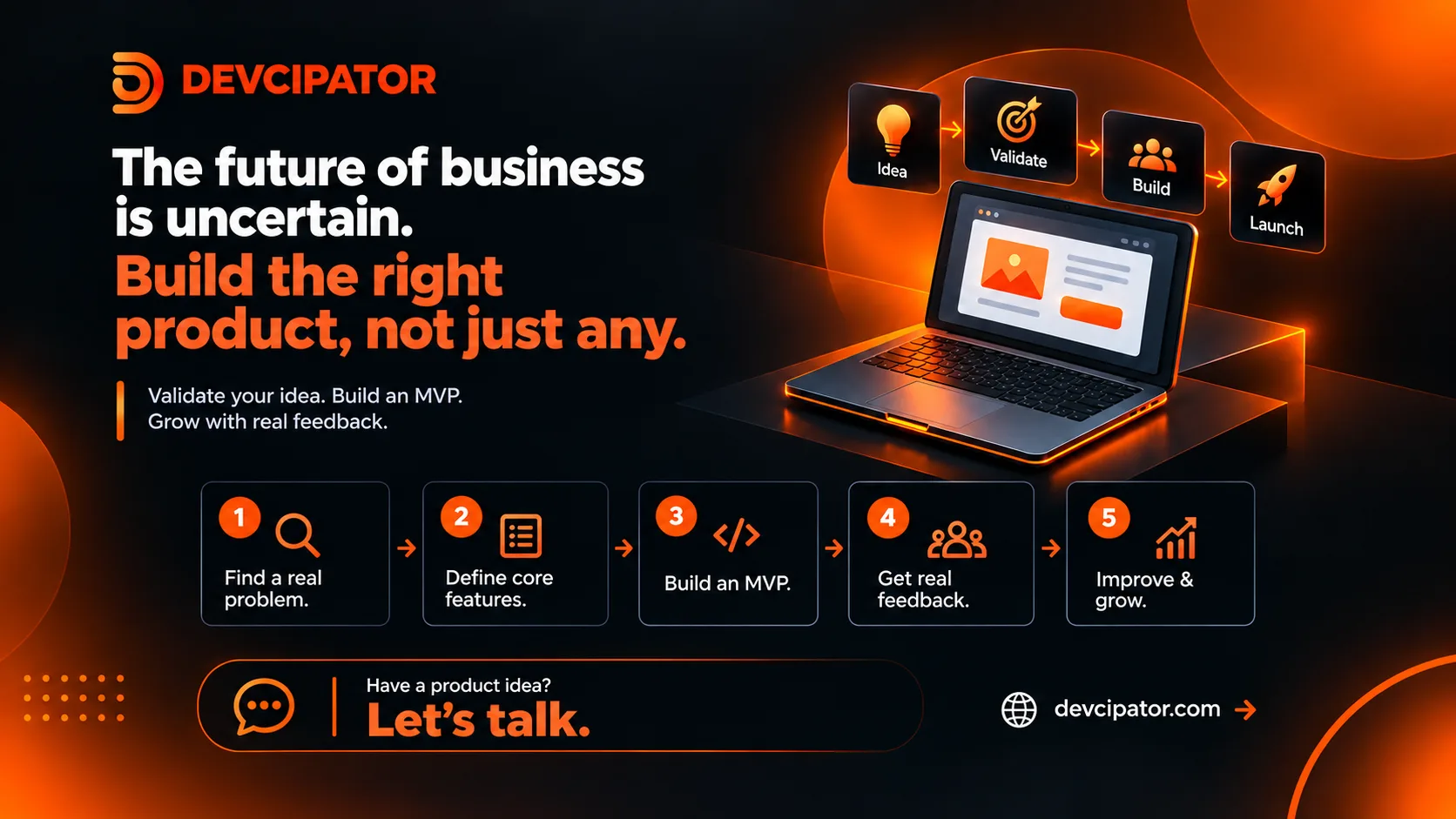
Building Your Next Product Shouldn’t Be a Guessing Game
Markets are unpredictable and budgets are tighter. Before you invest in a new product, validate the idea with a focused MVP and build the right thing first.
Startups Don't Need More Content. They Need More Useful Content.
Posting more won't fix your distribution. Before asking people to buy, book a call, or try your product, give them something that solves a real problem.