
Digital Product Development in 2026: From Idea to Launch and Beyond
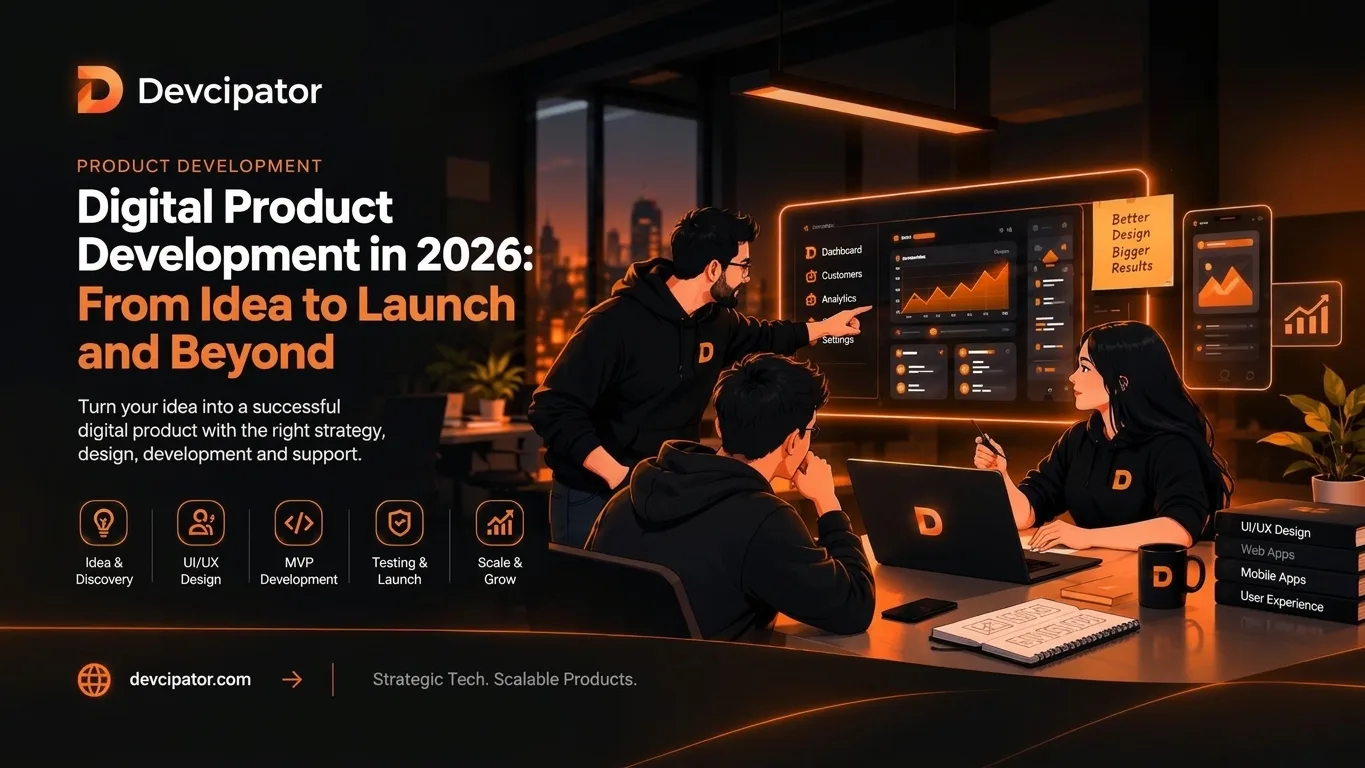
What Is Digital Product Development?
Digital product development is the end-to-end process of planning, designing, building, launching, and improving software-based products.
These products can take many forms, including:
Web applications: Online platforms, dashboards, customer portals, and business tools.
Mobile applications: Apps designed for smartphones and tablets.
SaaS platforms: Subscription-based software that customers access online.
AI-powered applications: Products that use AI for tasks such as intelligent search, document processing, and workflow automation.
Marketplaces: Platforms that connect buyers and sellers or different service providers.
Internal business tools: Custom systems that help teams manage operations, customers, inventory, or reporting.
Although these products serve different purposes, they share a common objective: solving a specific problem through technology.
A successful development process begins with understanding that problem before deciding which features to build or which technologies to use.
1. Start With Product Discovery and Strategy
Before investing in development, you need to establish what you're building, who it's for, and why people will use it.
Product discovery helps you turn an initial idea into a clearly defined business and product direction.
Identify your target audience
Start by understanding the people who will use your product. Consider their needs, daily challenges, existing tools, and expectations.
For example, if you're developing a project management platform for small businesses, your research might reveal that teams struggle with scattered communication, missed deadlines, and repetitive administrative tasks.
These insights help you focus on problems worth solving.
Define your core value proposition
Your value proposition explains why someone should choose your product over existing alternatives.
Ask yourself:
What problem does the product solve?
Who benefits most from the solution?
What makes the product useful or different?
Why would customers continue using it?
Clear answers help guide product decisions throughout development.
Research the market
Competitor research can reveal existing customer expectations, common features, pricing approaches, and opportunities for differentiation.
You don't necessarily need to create something completely new. You can build a valuable product by solving an existing problem more effectively for a particular audience.
The goal of product discovery is to reduce uncertainty before committing significant resources to development.
2. Validate Your Idea Before Building the Full Product
One of the biggest risks in product development is investing heavily in an idea before confirming that customers actually need it.
Idea validation helps you test assumptions early and make better decisions about your product's scope.
You can validate a product idea through several practical methods.
Customer interviews: Speak with potential users about their existing problems and how they currently solve them.
Landing pages: Explain your proposed solution and measure interest through registrations, inquiries, or waiting-list sign-ups.
Competitor analysis: Study existing products to identify gaps and understand customer expectations.
Prototypes: Create interactive design concepts that allow potential users to explore the product before full development begins.
Early commercial tests: Where appropriate, use paid pilots or early-access offers to test whether customers are willing to pay.
Validation doesn't eliminate every risk, but it gives you better information to work with.
Instead of building every feature you can imagine, you can focus on the functionality most likely to deliver meaningful value.
3. Build a Minimum Viable Product (MVP)
A minimum viable product, or MVP, is an early version of a product that delivers its core value while allowing you to learn from real users.
For startups and growing businesses, MVP development can provide a practical way to test an idea without committing to a complete product from the beginning.
Consider a founder planning to build a SaaS platform for managing client relationships.
The full product might eventually include advanced analytics, automated workflows, extensive integrations, custom reports, and team permissions.
However, the initial MVP might only need:
User registration and login
Customer record management
Basic communication tracking
A simple dashboard
Essential data management features
Once users begin interacting with the product, the team can identify which additional features deserve priority.
Why MVP development matters
A focused MVP can help businesses:
Launch an initial version sooner.
Control the scope of the first development phase.
Gather feedback from actual users.
Test assumptions about product demand.
Prioritize future features based on evidence.
An MVP should still be reliable, usable, and thoughtfully designed. The purpose is to reduce unnecessary complexity, not to sacrifice the essential quality of the product.
At Devcipator, MVP development is part of the journey from an initial concept to a functional digital product. The aim is to help founders focus on essential features and establish a practical foundation for future development.
4. Prioritize UI/UX Design
User interface and user experience design play an important role in whether people understand, adopt, and continue using a digital product.
UI design focuses on the product's visual interface, including layouts, typography, colors, buttons, and components.
UX design focuses on the overall experience: how users navigate the product, complete tasks, and achieve their goals.
Both are important when developing software that people can use confidently.
What does good product design include?
Effective UI/UX design typically considers:
Clear navigation and information hierarchy
Simple onboarding and registration
Consistent visual elements
Responsive layouts for different devices
Accessible interactions
Logical user flows
Feedback from usability testing
For example, a SaaS dashboard should help users find important information and complete common tasks without unnecessary confusion.
A visually attractive interface is useful, but good product design also makes the software easier to understand and operate.
Wireframes and interactive prototypes allow teams to explore layouts and user journeys before development begins. This can help identify design problems earlier, when changes are generally easier to make.
5. Choose the Right Development Technology
The technology behind your product influences how it is built, maintained, integrated with other systems, and adapted as requirements change.
There is no single technology stack that suits every digital product. The best choice depends on functionality, budget, expected usage, technical requirements, and future plans.
No-code and low-code development
Platforms such as Bubble and FlutterFlow allow developers to build applications using visual development tools and workflows.
These platforms can be useful for many MVPs, SaaS applications, internal tools, and products where rapid iteration is a priority.
Potential advantages include faster implementation of certain features and reduced reliance on writing traditional code for every part of the application.
However, platform limitations, subscription costs, integrations, performance requirements, and long-term flexibility should be evaluated before making a decision.
Custom software development
Custom development uses programming frameworks, databases, and other technologies to create solutions tailored to specific requirements.
Depending on the product, technologies such as React, Next.js, Node.js, PostgreSQL, and other modern tools may be appropriate.
Custom development can provide greater control over architecture, complex workflows, integrations, and application behavior. It may also require more engineering effort and ongoing maintenance.
AI-powered product development
AI can introduce capabilities such as intelligent assistants, document analysis, natural-language search, and automated workflows.
However, AI should be incorporated when it addresses a genuine user need. Product teams also need to consider reliability, privacy, operating costs, and appropriate human oversight.
Devcipator works across visual development platforms and modern software technologies to help businesses choose an approach that fits their product requirements.
The right technology is not necessarily the newest or most complex option. It is the one that helps you deliver the right product effectively.
6. Develop the Product in Clear, Manageable Phases
Once the requirements and design are established, development can begin.
Breaking the work into manageable phases makes it easier to review progress, identify issues, and keep the implementation aligned with the agreed scope.
A typical development process may include:
Phase 1: Technical planning
Define the application structure, database requirements, authentication, integrations, and core functionality.
Phase 2: Feature development
Build the application module by module, focusing on the functionality prioritized during product planning.
Phase 3: Integration
Connect required services, APIs, payment systems, AI models, or other external tools where applicable.
Phase 4: Progress reviews
Review working features regularly to confirm that the product meets expectations and to address issues before they accumulate.
Phase 5: Quality assurance
Test the application's workflows, responsiveness, permissions, integrations, and error handling.
A structured process helps keep product development focused while allowing teams to address problems as they arise.
7. Test the Product Before Launch
A product that works during development is not automatically ready for real users.
Testing helps identify issues that could affect usability, security, reliability, or performance.
The appropriate testing plan depends on the product, but it may include:
Functional testing: Confirming that features work as intended.
Usability testing: Checking whether users can complete important tasks.
Responsive testing: Reviewing the experience across supported screen sizes and devices.
Integration testing: Ensuring that connected services communicate correctly.
Security testing: Evaluating authentication, permissions, data handling, and other relevant risks.
Performance testing: Identifying slow operations and potential bottlenecks.
Testing should be considered throughout development, not simply as a final task before deployment.
Finding problems early can reduce rework and help deliver a more dependable experience.
8. Launch Your Product and Learn From Real Users
Launching your product makes it possible to move beyond assumptions and observe how customers actually use it.
Before release, prepare the production environment, verify essential workflows, configure monitoring where appropriate, and ensure that users can access the product successfully.
After launch, pay attention to how people interact with the product.
Useful metrics may include:
Activation rate: How many users reach an important first milestone?
Retention rate: How many users return over time?
Conversion rate: How many users take a desired action, such as purchasing a subscription?
Churn rate: How many paying customers stop using the service?
Customer feedback: What do users like, struggle with, or want improved?
Choose metrics that reflect your product's goals rather than tracking numbers simply because they are available.
For example, a SaaS product may benefit more from understanding customer retention than from focusing exclusively on total registrations.
These insights can help guide improvements and determine which features should be developed next.
9. Plan for Scalability Without Overengineering
Every product should have a reasonable path for growth, but that doesn't mean building an unnecessarily complex architecture from the beginning.
Overengineering can consume resources that would be better spent validating demand, improving the user experience, or developing essential features.
Instead, focus on a foundation that suits your current requirements and can evolve as the business grows.
Important considerations include:
Appropriate database design
Secure authentication and access permissions
Maintainable application architecture
Reliable backups and error monitoring
Clear API and integration boundaries
Performance monitoring
Documentation and ownership of technical assets
As usage increases, you can improve infrastructure and optimize the areas that actually require attention.
A scalable product is not simply one designed for large numbers of users. It is a product whose technology and development process can adapt to changing business needs.
10. Maintain and Improve Your Product After Launch
Product development continues after release.
Users may encounter unexpected issues, business requirements may change, and new opportunities may emerge from customer feedback.
Ongoing product maintenance helps keep the application functional, secure, and aligned with its intended purpose.
Depending on the product, post-launch work may involve:
Bug fixes and troubleshooting
Security updates
Performance improvements
Feature enhancements
Third-party integration updates
Usability improvements
Infrastructure adjustments
It's also important to distinguish between maintenance and product evolution.
Maintenance helps preserve the product's reliability, while product evolution introduces improvements that respond to new user needs or business opportunities.
Both contribute to a sustainable product lifecycle.
Devcipator offers optional ongoing maintenance and support, allowing businesses to seek continued assistance with troubleshooting, enhancements, and updates after launch.
Common Digital Product Development Mistakes to Avoid
Even well-planned projects can encounter difficulties when teams overlook fundamental product development principles.
Building before validating: Research your audience and test demand before making a major development investment.
Adding too many features: Prioritize the core use case and defer features that aren't essential to the initial release.
Ignoring UI/UX design: Make the product understandable and practical, not just technically functional.
Choosing technology without considering requirements: Evaluate costs, integrations, maintainability, and flexibility before committing.
Skipping thorough testing: Verify essential workflows and address significant issues before launch.
Ignoring user feedback: Use real customer behavior to guide product improvements.
Treating launch as the finish line: Plan for maintenance, iteration, and continued development.
Avoiding these mistakes cannot guarantee commercial success, but it can help teams make more informed decisions and use their resources effectively.
How Devcipator Helps Bring Digital Products to Life
Building a digital product requires the right combination of product thinking, design, development, and technical planning.
Devcipator works with startups and businesses to turn ideas into functional digital solutions, from early-stage MVPs to SaaS platforms and AI-powered applications.
Our product development approach covers key stages of the process:
1. Free consultation
Discuss your idea, requirements, goals, and potential development approach before defining the project scope.
2. UI/UX design
Plan the user experience and create application designs using tools such as Figma or Adobe XD. Development begins after the design has been approved.
3. Development
Build the agreed functionality, including relevant application workflows, authentication, database architecture, and integrations.
4. Testing and deployment
Test the application, address issues, and prepare it for launch.
5. Handover and training
Receive guidance on managing your application and making supported minor layout or content changes.
6. Optional ongoing maintenance
Continue improving and maintaining your product as your needs evolve.
Depending on the project, Devcipator can help with MVP development, SaaS product development, Bubble.io applications, custom software, AI applications, web and mobile apps, and UI/UX design.
The objective is to build a product around your business requirements, rather than adding unnecessary complexity.
Conclusion
Digital product development is a journey that connects an initial idea to a working solution and then evolves that solution in response to real-world needs.
The process begins with understanding your users and validating your idea. It continues through product strategy, MVP development, UI/UX design, technology selection, engineering, testing, and launch. After release, feedback and ongoing maintenance help the product improve over time.
You don't need to build every feature on day one. You need a clear direction, a focused first release, and a practical plan for learning and improving.
When these elements work together, product development becomes a more structured way to turn business ideas into useful digital experiences.
Ready to Build Your Digital Product?
Have an idea for a SaaS platform, web application, mobile app, or AI-powered solution?
Devcipator can help you explore your requirements, define a practical development approach, and move from concept toward launch.
Visit Devcipator.com to explore our services and discuss your product goals with our team.
Related articles
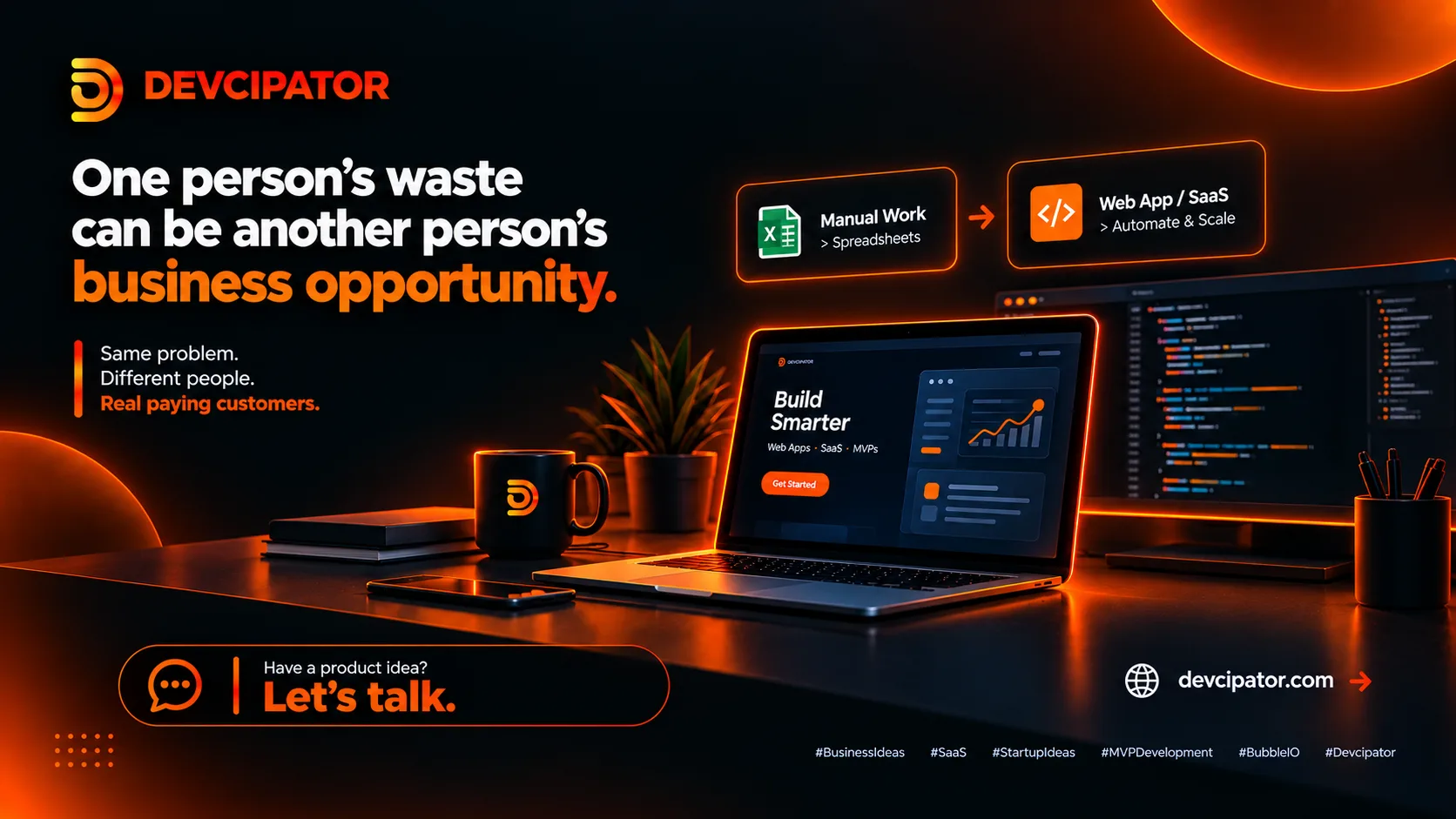
One Person’s Waste Is Another Person’s Business Model
A construction company pays to remove dirt that a developer ten miles away pays to buy. The same principle applies to software: the best opportunities come from seeing value where others see waste.
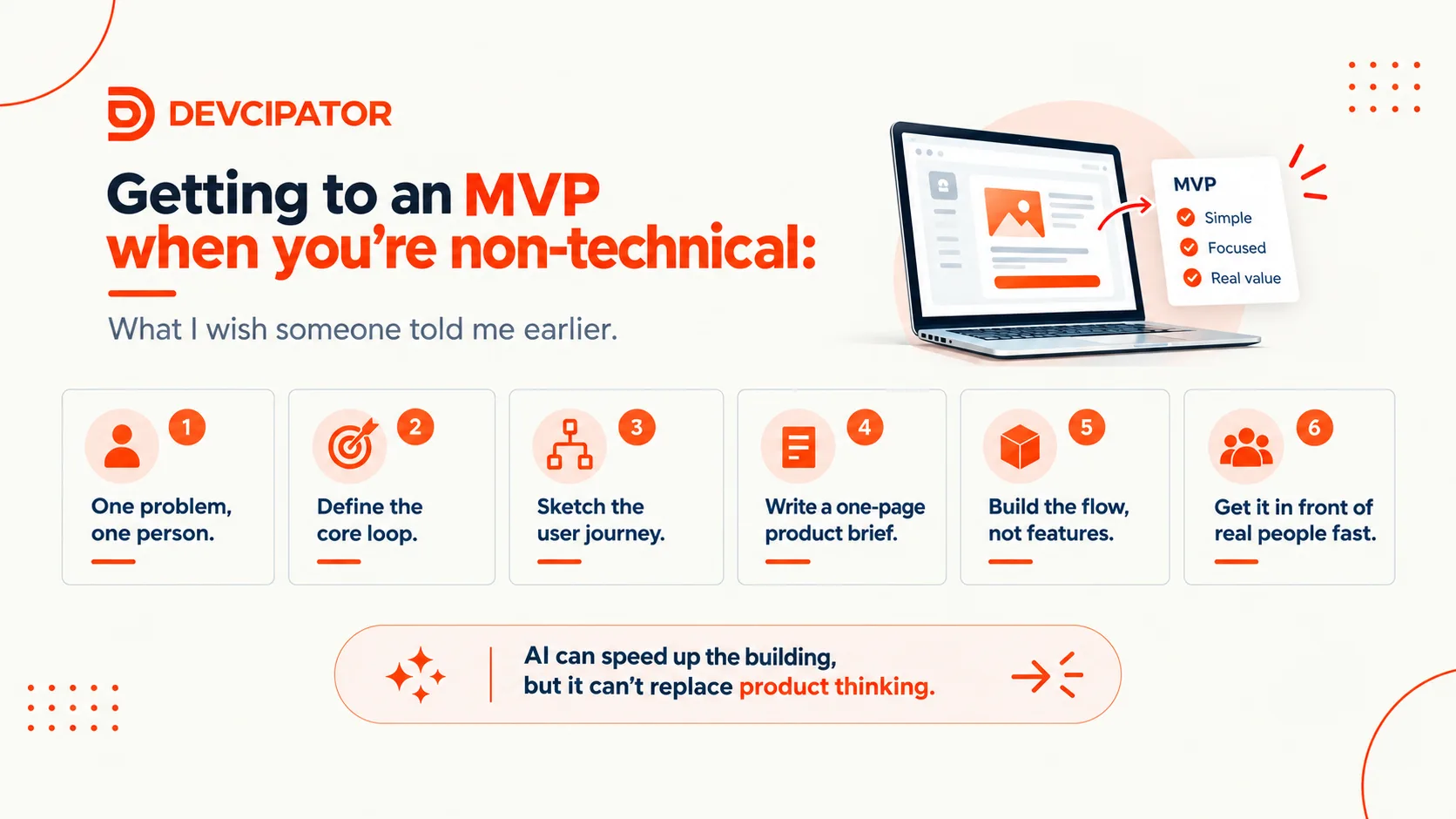
Getting to an MVP When You're Non-Technical: The Process I Wish I'd Known Earlier
AI tools mean anyone can build, but the hard part was never the building. It's knowing what to build. Here's a simple, practical process for going from "I've spoken to users" to a coherent MVP, without ending up with AI slop.
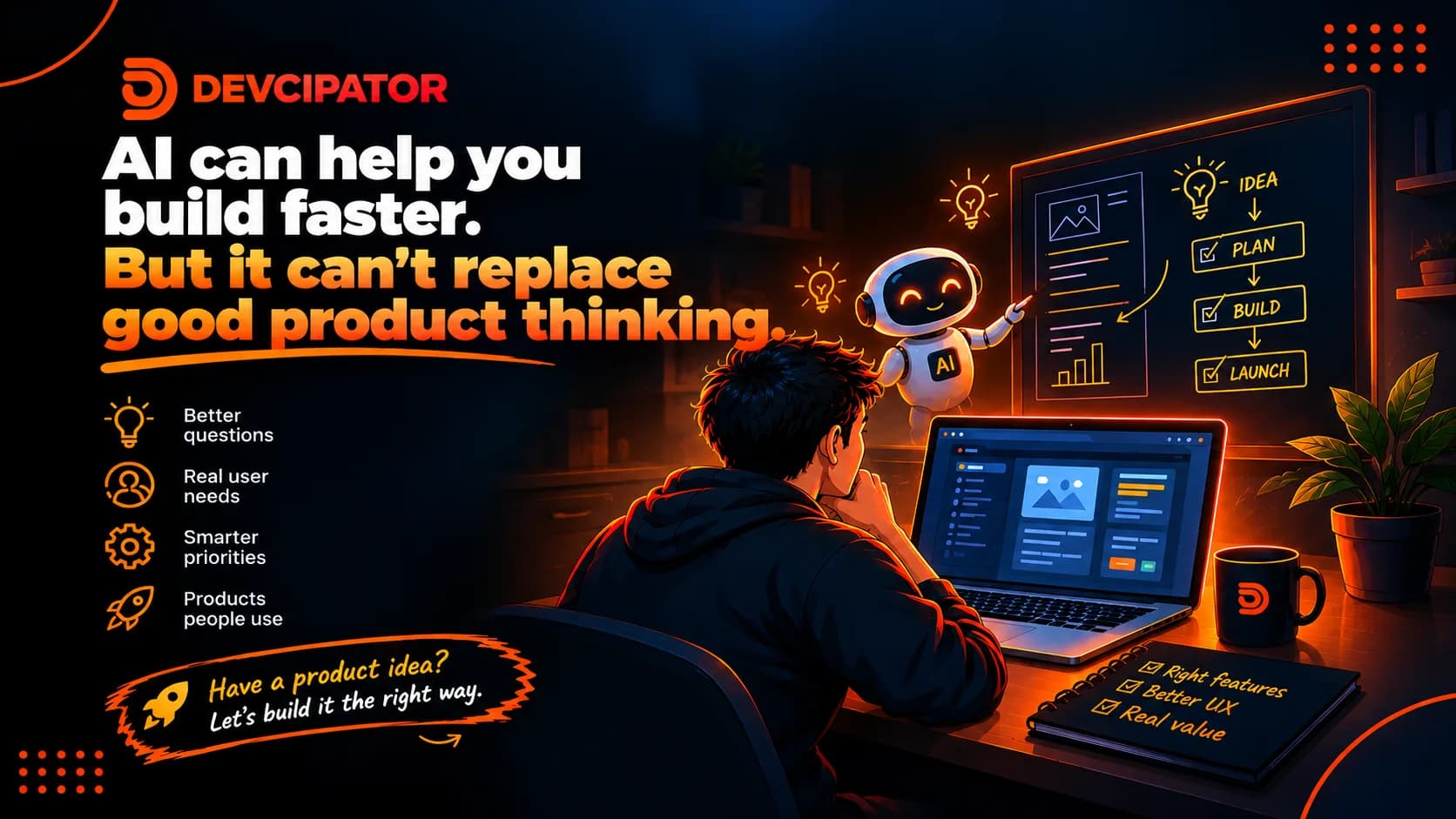
AI Can Help You Build Faster, But It Can't Replace Good Product Thinking
AI tools make building faster than ever, but knowing what to build still takes real product thinking. Here's why the hard part of launching a web app, SaaS, or MVP isn't development.