How to Build an MVP with No-Code Without Sacrificing Scalability
Founders often treat building an MVP, choosing no-code, and planning for scalability as three separate decisions. In reality, they are closely connected. The technology and development approach you choose for your MVP can directly influence how easy or difficult it will be to grow your product later.
The right approach is not simply about choosing between no-code and custom development. It is about validating your idea quickly, building only what matters, and creating a technical foundation that can support your business as it grows.
The purpose of a Minimum Viable Product (MVP) is not to build every feature you can imagine. It is to test the core assumption behind your business: Do real users want this product enough to use it, and ideally, pay for it?
Every feature built before that validation is essentially a hypothesis. The more time and money you invest in unvalidated features, the more expensive it becomes to change direction later.
A strong MVP should therefore focus on the smallest set of features needed to:
Solve the core problem
Deliver the primary value proposition
Collect meaningful user feedback
Test user behavior and demand
Validate whether customers are willing to pay
This is where no-code development can significantly change the equation.
Modern no-code platforms such as Bubble.io allow businesses to build functional web applications without developing every component from scratch.
Depending on the platform and project requirements, you can create features such as:
User authentication
Database structures
Custom workflows
Role-based permissions
Subscription and payment systems
API integrations
Admin dashboards
SaaS functionality
Automated business processes
Instead of spending months building infrastructure before users can interact with the product, founders can often move from idea to functional MVP much faster.
The real advantage is not simply that no-code requires less coding. The bigger advantage is that it reduces the distance between validation and implementation.
You can build something real, put it in front of users, learn from their behavior, and improve it without committing excessive resources to features that may never be needed.
One of the most common objections to no-code development is that you will eventually "hit a wall" and have to rebuild the entire product using custom code.
That concern comes from an older perception of no-code platforms.
Modern platforms have become considerably more capable and can support many of the requirements found in real-world SaaS applications, including multi-user systems, multi-tenant architectures, subscription billing, role-based access control, databases, APIs, and third-party integrations.
For example, platforms such as Bubble can integrate with services including Stripe, OpenAI, and Google Maps through APIs and plugins.
However, this does not mean that every no-code application will scale automatically.
That distinction is important.
Scalability is not simply a question of whether you choose no-code, low-code, React, or another development technology.
Architecture matters.
A poorly structured application can become difficult to maintain regardless of the technology used to build it.
For example, a rushed MVP with:
Poor database relationships
Duplicated data
Inefficient workflows
Weak permission structures
Unnecessary backend operations
Poor API design
Unoptimized queries
can create serious performance and maintenance problems as the product grows.
The same principle applies to custom-coded applications. Using React or another programming framework does not automatically guarantee that a product will scale.
A well-architected no-code application can therefore be significantly more sustainable than a poorly architected custom-coded application.
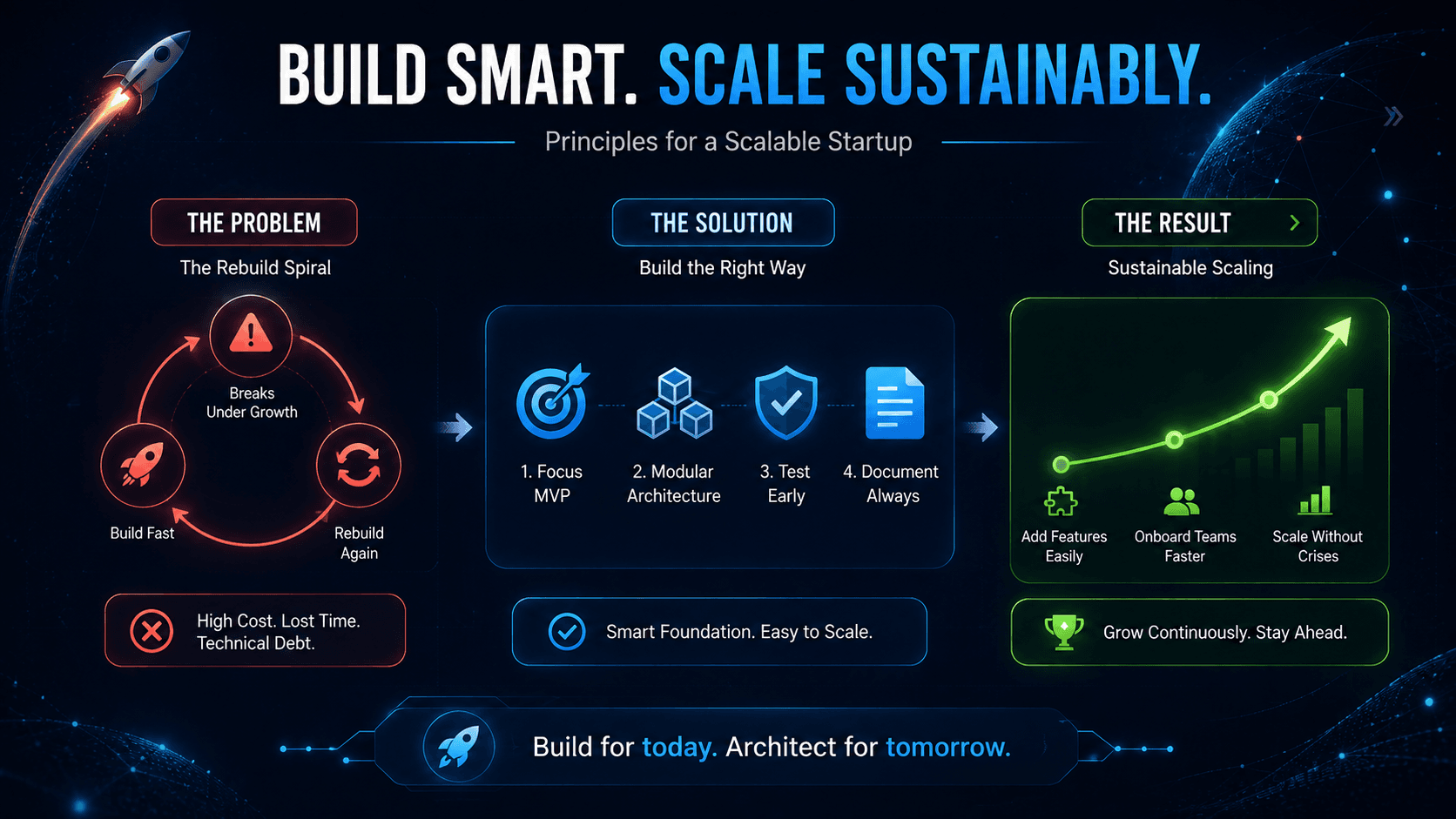
The goal should not be to build for millions of users on day one. The goal is to create an architecture that can evolve as your user base, feature set, and business requirements grow.
The difference between a fragile MVP and a scalable product often comes down to the development process.
A reliable process should look something like this:
Before development begins, define the problem the product solves, who it serves, and what the MVP actually needs to accomplish.
Separate essential functionality from features that can be added later.
The question should be:
What is the smallest product we can build that meaningfully tests the business idea?
Before building complex workflows, create the product's interface and user experience in Figma.
This allows the team to establish:
User flows
Page structures
Navigation
Responsive layouts
Visual hierarchy
Interaction patterns
Component consistency
Designing before development also reduces unnecessary changes during implementation.
Once the design is approved, development should proceed systematically.
Instead of building the entire application simultaneously, break it into logical modules and develop each one against the approved design.
For example:
Authentication → User Dashboard → Core Product → Payments → Admin Panel → Integrations
This approach makes development easier to test, review, and maintain.
An MVP should be minimal, but it should not be careless.
Before launch, test:
User registration and login
Core workflows
Database operations
Permissions
Payment flows
API integrations
Responsive behavior
Error handling
Edge cases
The objective is to launch quickly without sacrificing basic product reliability.
Do not spend months optimizing an MVP for hypothetical traffic.
First, determine whether users actually want the product.
Once real usage data becomes available, optimization can focus on actual bottlenecks rather than assumptions.
This might include improving database performance, reducing unnecessary workflows, optimizing API calls, restructuring data, or improving the user experience.
A successful MVP is not only about launching the product. It is also about creating a foundation that the business can continue to manage.
A well-built application should allow founders or internal teams to make reasonable content and configuration changes without requiring a developer for every small update.
For example, businesses should ideally be able to manage appropriate areas such as:
Website content
Product information
Basic settings
User-facing text
Images
Pricing information
Certain administrative workflows
The exact level of control depends on the application's architecture and requirements.
Good handover documentation and a maintainable structure are therefore just as important as the initial development itself.
The debate should not simply be:
"Should I use no-code or custom code?"
A better question is:
"Which technology and architecture are appropriate for this product, its current stage, and its expected growth?"
No-code can be an excellent choice when speed, validation, flexibility, and cost efficiency are priorities.
Custom development may be more appropriate when a product requires highly specialized functionality, unusual infrastructure, or technical requirements that the selected no-code platform cannot reasonably support.
There is no universal answer.
The right decision depends on the product.
Founders sometimes make the mistake of trying to build a production-scale system before they have production-scale demand.
That can waste significant time and resources.
The better strategy is to build an MVP that is intentionally designed to evolve.
Validate the idea.
Build the essential functionality.
Use a platform capable of supporting real users, integrations, and payments.
Structure the database and workflows properly.
Then use real-world usage to determine what needs to scale next.
This turns scalability from a vague future problem into a series of measurable engineering decisions.
The founders who scale successfully are not necessarily the ones who chose custom code over no-code, or no-code over custom code.
They are the ones who validated their idea before overbuilding, selected an appropriate technology, and invested in good architecture from the beginning.
A properly planned no-code MVP does not have to be a temporary prototype that gets thrown away when the business grows.
It can become the foundation of a real product.
The goal of an MVP is not to predict the future perfectly. It is to learn quickly, validate demand, and build a foundation that can evolve with the business.
If you're deciding between MVP development speed and long-term scalability, you do not necessarily have to choose one over the other.
They only become conflicting goals when the first version is built without a clear strategy.