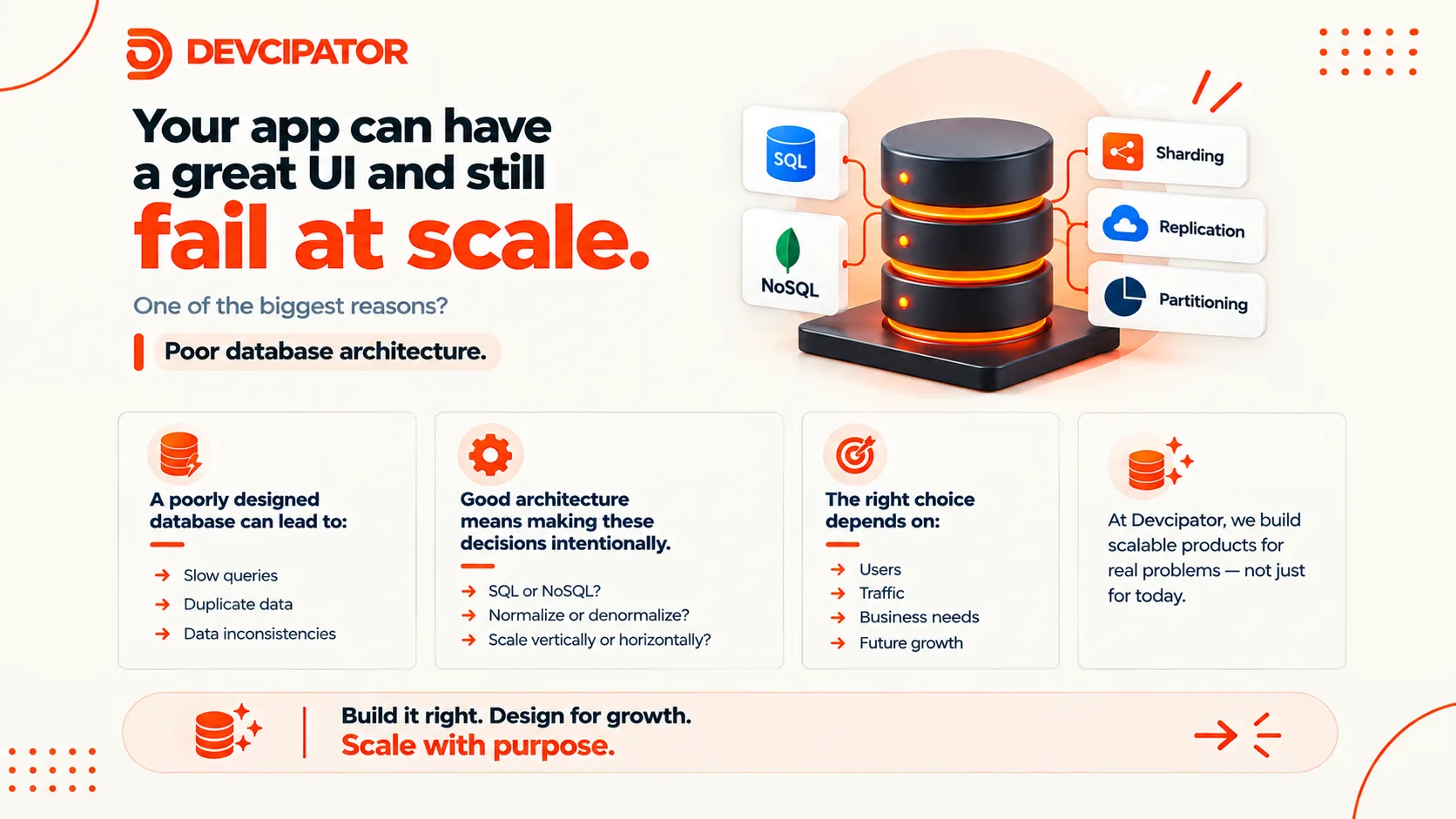
Your app can have a great UI and still fail at scale.
One of the biggest reasons? Poor database architecture.
When building a website, SaaS product, or custom application, database design is often treated as something developers can figure out later. That's a risky assumption, and it can become very expensive.
A database that wasn't designed with care rarely causes problems on day one. The cracks show up as your users, data, and traffic grow. A poorly designed database can lead to:
Slow queries that make your app feel sluggish
Duplicate data spread across tables
Data inconsistencies that erode trust in your product
Higher server load and rising infrastructure costs
Difficult scaling when growth finally arrives
Expensive rewrites that pull your team away from building features
By the time these issues are visible to users, fixing them usually means touching every part of the system.
Good database architecture isn't about picking the trendiest technology. It's about making key decisions intentionally, before they're made for you by default.
The Questions Worth Asking Early
SQL or NoSQL? Do you need strict structure and relationships, or flexible, schema-light data?
Normalize or denormalize? Do you want clean, consistent data, or faster reads at the cost of some duplication?
Vertical or horizontal scaling? Will you add more power to one machine, or spread the load across many?
Replication, partitioning, or sharding? How will your data be distributed, protected, and accessed as it grows?
Each of these choices has trade-offs, and none of them has a universal right answer.
A simple business application may benefit from a well-normalized relational database, with clean data, strong consistency, and straightforward reporting.
A high-traffic platform, on the other hand, may intentionally denormalize certain data to make reads dramatically faster, accepting some added complexity in exchange for speed.
Neither approach is wrong. The right one depends on the problem you're solving.
What the Right Choice Depends On
Users: how many, and how they behave
Traffic: read-heavy, write-heavy, or spiky
Data relationships: how connected your data really is
Business requirements: consistency, compliance, reporting needs
Future growth: where the product is headed, not just where it is today
At Devcipator, we believe scalable products should be designed for the problem they're actually solving, not just built to work today.
That means asking the hard questions early, choosing architecture with intent, and leaving room for growth, so your product doesn't need a painful rebuild just when it starts to succeed.
Build it right. Design for growth. Scale with purpose.